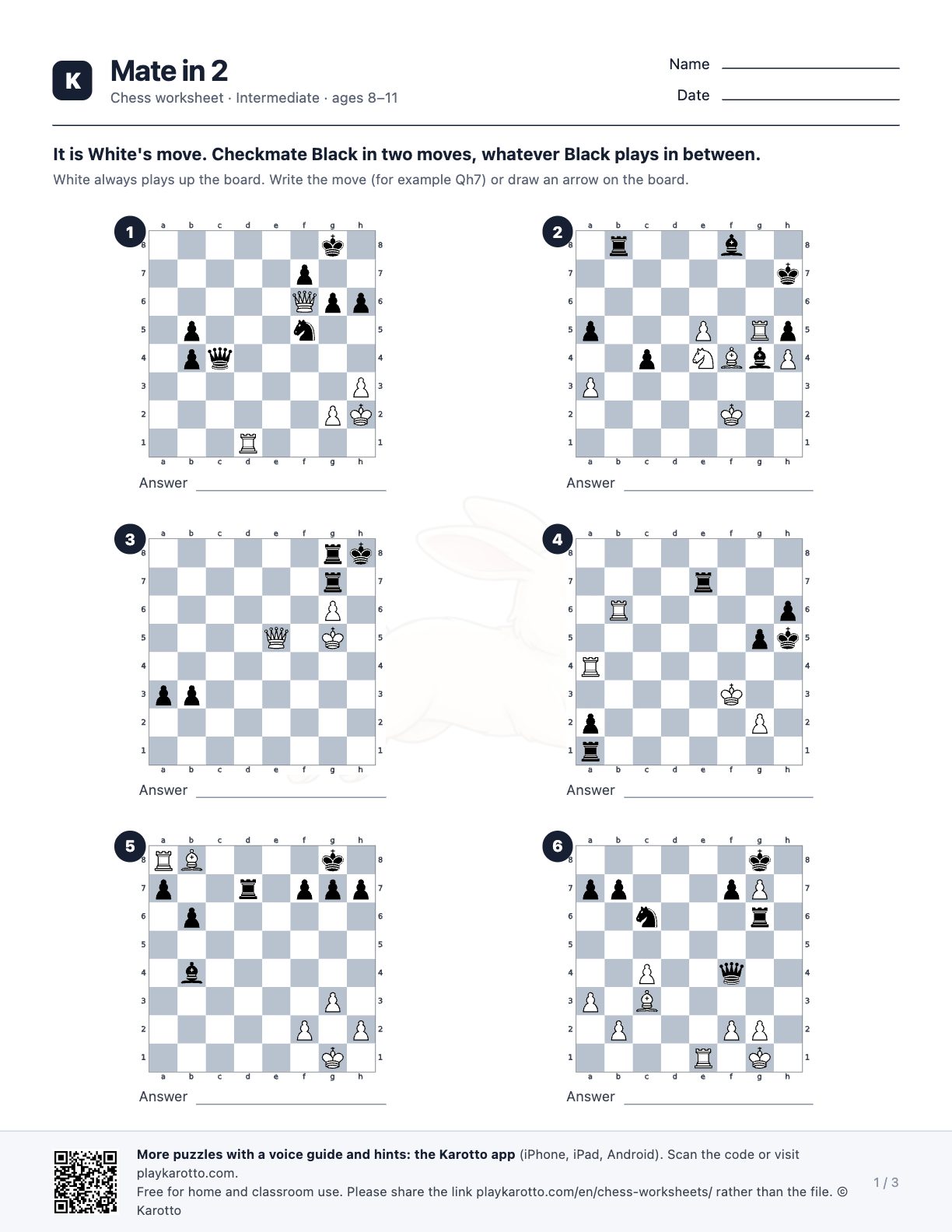
What this worksheet practises
Mate in two teaches children to stop looking only at their own move and to ask, "what will my opponent do next?" It is the bridge between pattern recognition and real calculation.
For every puzzle we checked all of Black's possible replies: the first move leads to checkmate no matter what Black plays, there is no faster mate in one, and no other first move works.
Try two puzzles now
It is White's move. Checkmate Black in two moves, whatever Black plays in between. These are the first two puzzles from the sheet.
Show answer
1. Rd8+ Kh7 2. Rh8#
Show answer
1. Nf6+ Kh8 2. Rg8#
Tips for parents and teachers
- Look for checks, captures and threats first, in that order. Most first moves on this sheet are one of the three.
- Once your child has a first move, ask them to play Black and try every defence.
- If a puzzle is too hard, cover the board and set up only the pieces near the black king.
Want more than 12 puzzles?
Karotto's chess course walks children from how the pieces move to checkmate patterns and tactics, one short lesson at a time. A friendly voice reads every step aloud, and when your child is stuck, the app shows why a move works instead of just giving the answer.
Questions
Is this chess worksheet really free?
Yes. You can print it as many times as you like for your own children, your class or your chess club. We only ask that you share the link to this page rather than uploading the PDF somewhere else.
What age is the Mate in 2 worksheet for?
It suits children of about 8–11 who already know how all the pieces move. Age matters less than experience: if your child solves fewer than 7 of the 12 puzzles, try the previous sheet in the series first.
Does my child need to know chess notation?
No. Children can draw an arrow on the board to show their move. The answer key uses standard notation (for example Qh7#) and also shows each first move as a green arrow.
Where do the puzzles come from?
Every position comes from a real game in the Lichess.org puzzle database, which is released into the public domain (CC0). We picked easy, popular puzzles and checked each one with a chess program so that it has only one correct answer.
Puzzle positions: Lichess.org puzzle database, CC0. Worksheet design © Karotto, free for personal and classroom use.