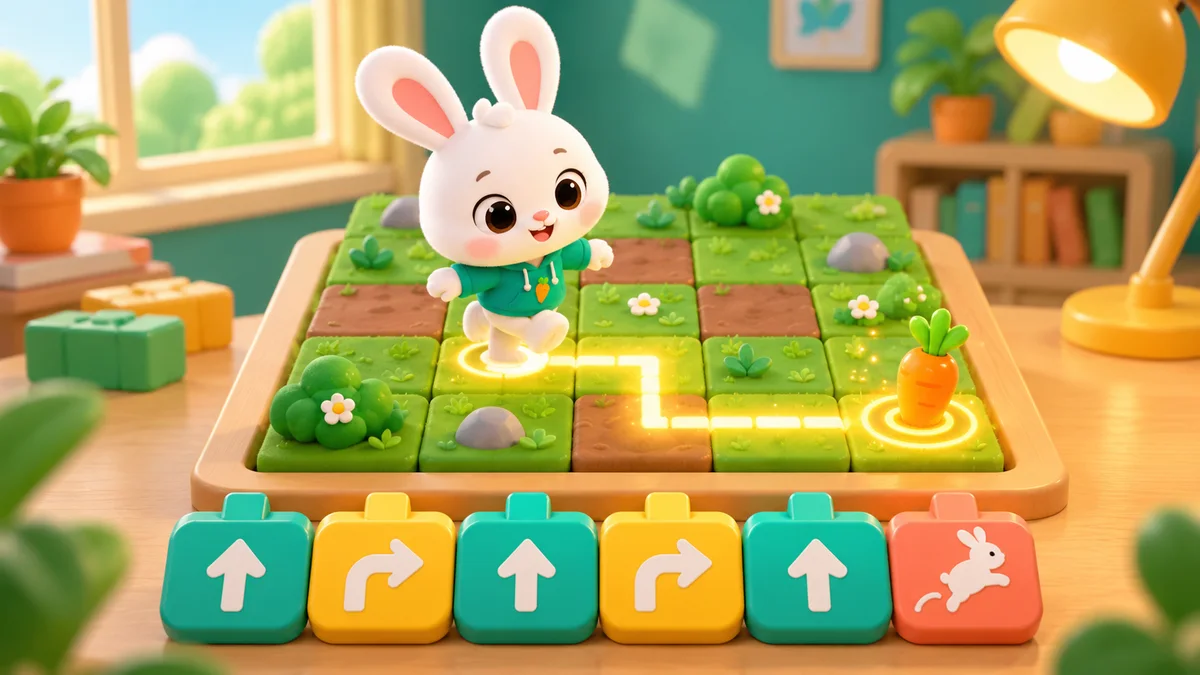
What do children learn in the Programming course?
Each lesson is a small map that fits on a phone screen, with Rabbits, carrots, corn and some obstacles. Children combine blocks forward, turn left, turn right, jump, harvest carrots, harvest corn into a program to let the Rabbit go on the right path and pick all the vegetables. The small map helps children see the whole problem.
The six keys K1–K6 go from easy to difficult in the correct order of the fundamental concepts of programming:
In each concept, children encounter many types of problems: see sample, choose answer, read the code and guess the result, guess the box The rabbit stops, build your own program, find errors, compare two programs and fill in the missing part. Changing the lesson format helps children understand a concept from many sides.
What does a lesson look like?
Photo taken from the real app, in mid-course lessons:
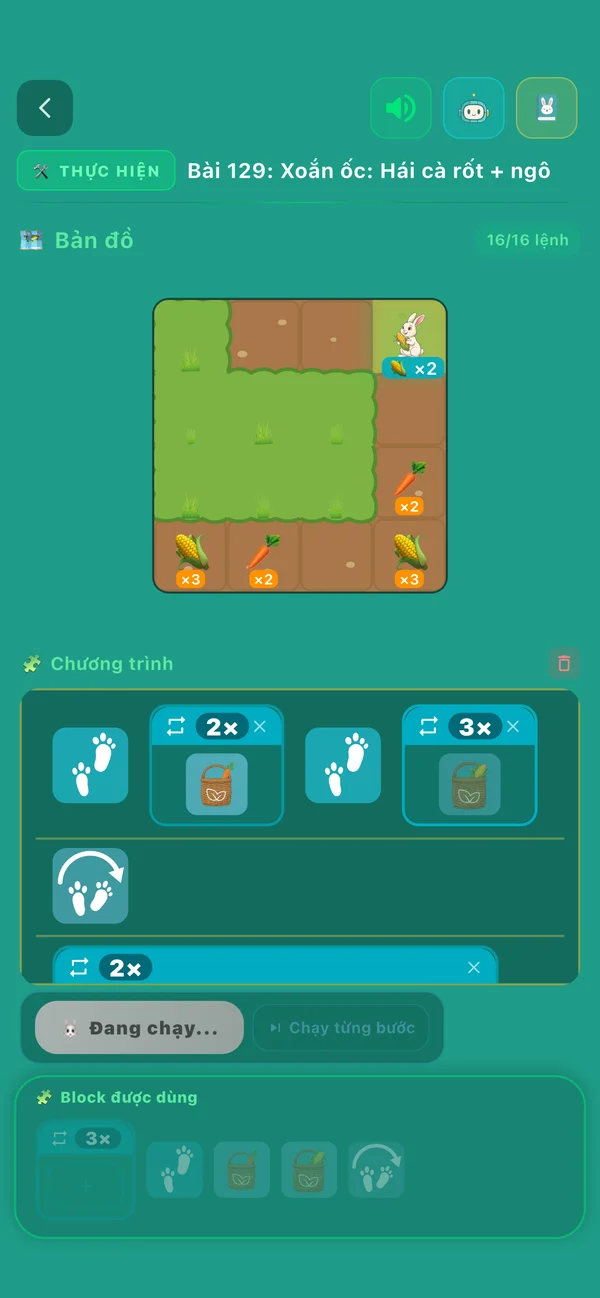
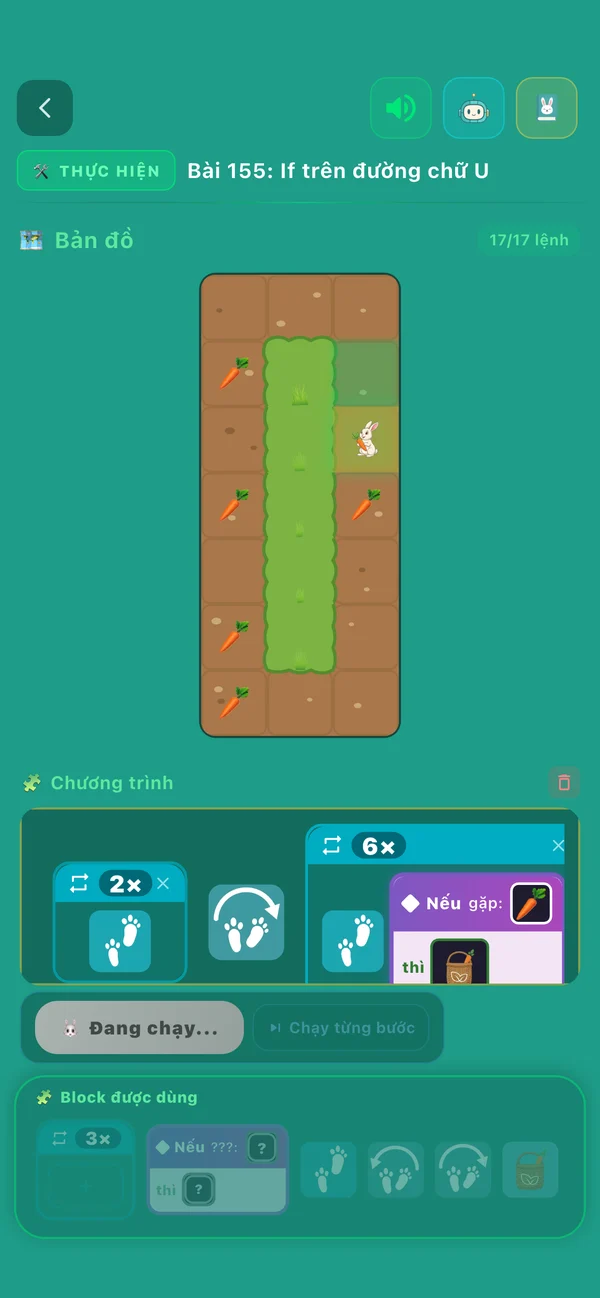
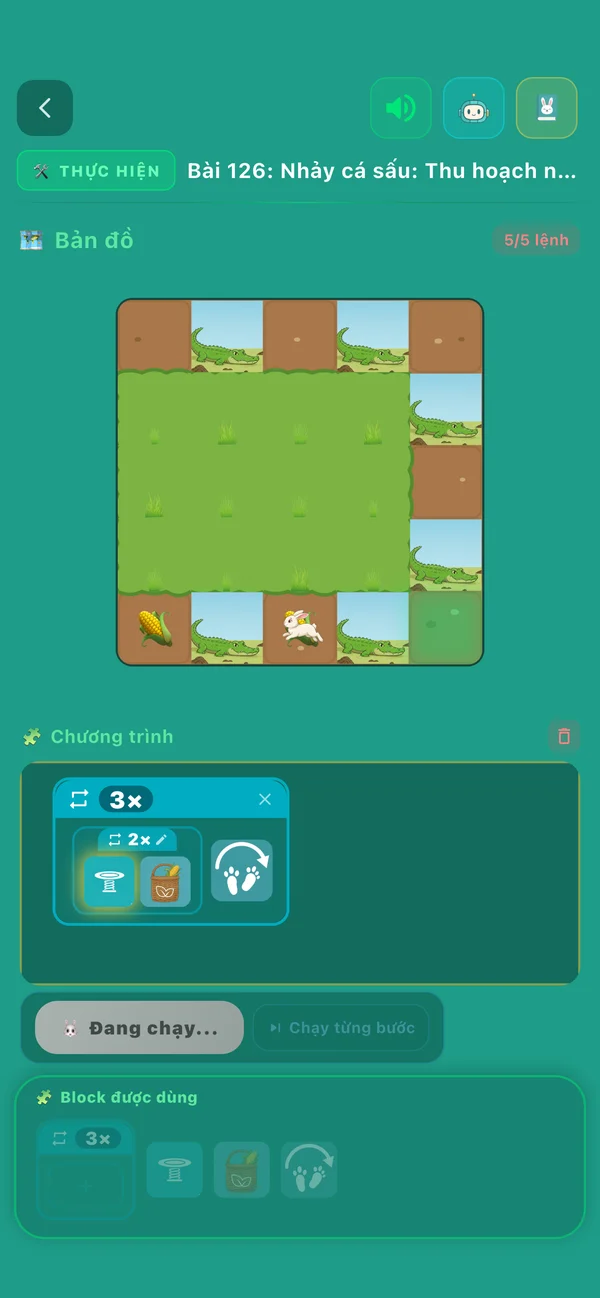
Children press Run to see the whole program, or Run step by step to see which block is lit and the Rabbit where are you?
Why can children learn on their own?
- Voice reading out loud: Topics, instructions and comments are all read aloud, available in Vietnamese and 12 other languages. Children 5–6 years old who can't read well can still do it themselves.
- Indicate the first command that goes wrong: When the program is wrong, the app does not only indicate "wrong" but only the first block of commands correctly, causing the Rabbit to go on a different path, so that the child can correct the correct place.
- Hints for each step: if you're stuck, ask the robot. The first suggestion is only a light reminder, the following steps are gradually clearer, so the child still has to think for himself.
- Stars and stickers after each lesson, the more concise the program, the more stars.
Tuition fee: free every day, Premium one-time purchase
Every day your child can study for free a reasonable amount of cards, and all islands are open. At the end of the day, Thỏ Bông makes an appointment for your child tomorrow, keeping a healthy learning rhythm instead of sitting in front of the screen.
Premium is a one-time purchase, lifetime use. This package offers unlimited learning every day. This is not a monthly or annual subscription, so there are no periodic deductions, including the months your child is not studying. The app has no ads.
Articles for parents
- Where should children start learning programming?
- Should children learn programming early?
- How does programming help children develop thinking?
- How long should children learn programming each day?
- Scratch or Python: what should children learn first?
- Top 5 programming apps for children
- Why should children still learn programming in the AI era?
Frequently Asked Questions
What age child can learn programming with Karotto?
The course is suitable for children 5–11 years old. Children 5–6 years old start with short sequences. Thanks to the voice, they don't need to read fluently yet. Older children go quickly through the first part and spend time on loops, variables, lists, functions.
Does the child have to type code?
No. Children drag and drop command blocks shaped like feet, turn arrows, and harvest baskets. Children still learn the same concepts of real programming such as loops, conditions, variables and functions, just without having to type syntax.
Can parents who don't know how to program accompany their children?
Okay. The app automatically reads the question, scores it and indicates the first incorrect command. Parents just need to sit next to their children and ask, "Where will the rabbit go?" before pressing run, and keep a steady pace of studying every day.
How long should a child study each day?
For small children, 15–20 minutes a day is just right. The amount of free cards per day of Karotto is also set at a reasonable level; Your turn is over, Thỏ Bông will see you tomorrow.
Let your child try his first programming lesson
329 command block matching exercises, with Vietnamese voice, no ads. Every day learn a suitable amount of lessons for free.