An app Chess that is good for adults is not necessarily good for 6-year-old children. Adults need opponents, puzzles and leaderboards. Children need a guide: which lessons to learn first, where they went wrong, why they went wrong, and an environment where parents feel secure to let their children use themselves.
Transparency note: Karotto is the app of the team that makes this website, so it should be ranked first and described in more detail. The remaining apps are popular choices; We only describe certain points and advise parents to check prices and features on the app store themselves as they are subject to change.
5 criteria for choosing a chess learning app for children
1. Is there a roadmap from easy to difficult?
Chess has a pretty clear learning order: how to move a piece, then take a safe piece, check and checkmate, then tactical moves like double attack, pinning. A good app for children will guide them in that order, not letting them choose haphazardly among thousands of puzzles. Try opening the app and see: what is the first lesson, what is the tenth lesson, is there a review lesson or test at the end? The article 6-stop route can be used as a "measure" for comparison.
2. Is there a reading voice for children who cannot read well?
This is the most overlooked criterion. Most children 5–7 years old cannot read a long instruction sentence fluently. If the app only has text, parents will have to sit next to it and help read it the entire time, and the child cannot properly "self-study". The App has a voice to read instructions and comments to help children learn independently much sooner.
3. Is there an explanation of why it's wrong and why it's right?
The "Wrong, try again" indicator makes your child guess until he wins. A good explanation shows the child the consequences: "If you go like this, the opponent will get the cart". When making a correct move, the child should also be able to see why that move is good, so that next time he can recognize the same pattern in the real game.
4. Is it safe for children?
For children, safety consists of two parts. Firstly, don't chat with strangers, or at least parents can turn off chat. Second, there are no ads, because ads can easily lead children to mistakenly click outside or to inappropriate content. Online play platforms for adults often require parents to adjust settings more carefully.
5. Price model: one-time purchase or subscription?
Many apps use monthly or yearly subscription packages: money is automatically deducted each period until parents actively cancel. This is reasonable for adults who play regularly, but for children, the study rhythm often fluctuates: during semester exams, children almost do not open the app, and during summer vacation they study a lot. With a subscription, The month the child does not study is still charged, and many families only find out when looking at the statement.
The one-time purchase model is simpler: pay once, use for a long time, don't worry about forgetting to cancel. When comparing, calculate the total cost for the period of time your child actually learns, for example a year or two, and don't just look at the price of a month.
Chess learning apps for children worth considering
1. Karotto: 6 Step roadmap, voice reading, one-time purchase
Suitable for: children 5–11 years old are just starting out, especially children who are not yet fluent in reading, and families want them to self-study according to the available roadmap.
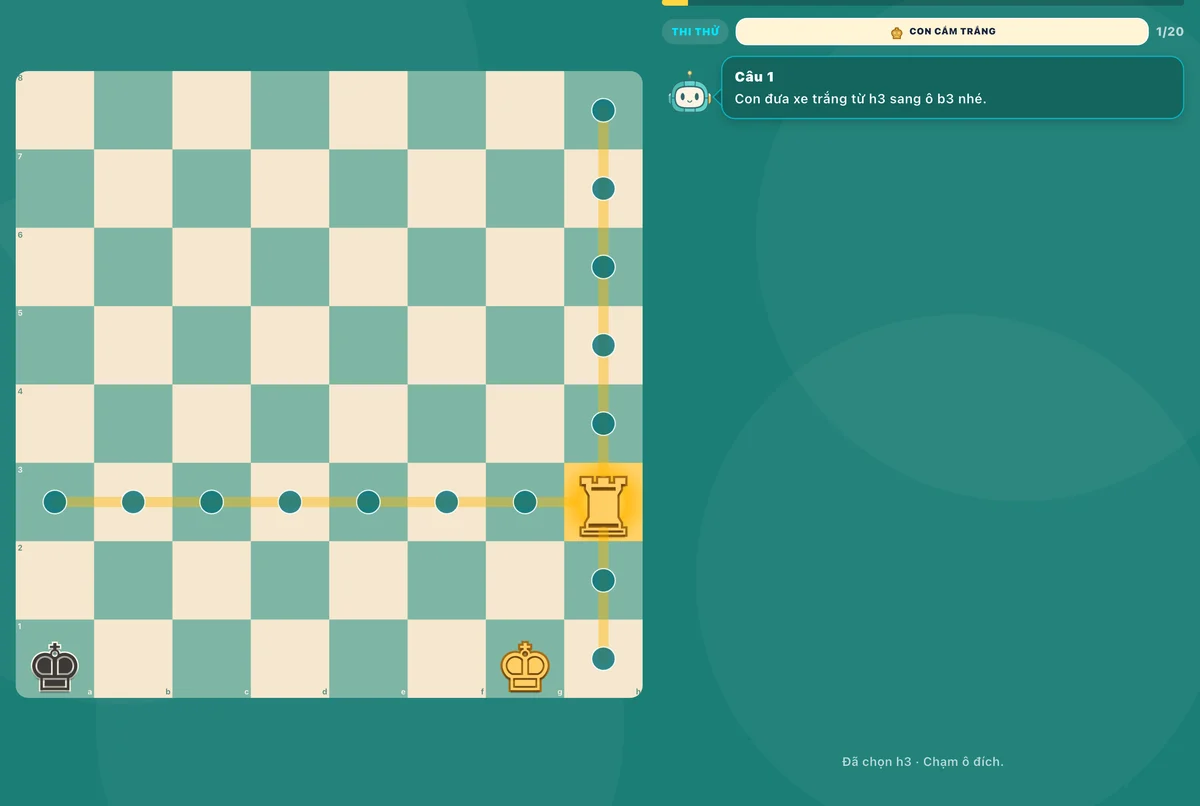
Karotto is a thinking learning app with 4 subjects: Programming, Math, Chess and Cube. The Chess course has 283 lessons, divided into 6 Steps, from getting familiar with the chess board, how to move pieces, checkmate, castling, promotion in Step 1, to double attack, pin, open check, endgame, planning in the following Steps. At the end of each Step, there is a Review lesson and a 20-question practice test.
Each lesson has a "Sample study" section (see sample moves with arrows) then "Practice" (child walks on his own). When the child makes a mistake, the chessboard replays the consequences, for example "King runs to h7? White Queen is aiming for that square!". When you make the right move, the chessboard shows why that move is good. If the child is puzzled, the robot will suggest each step.
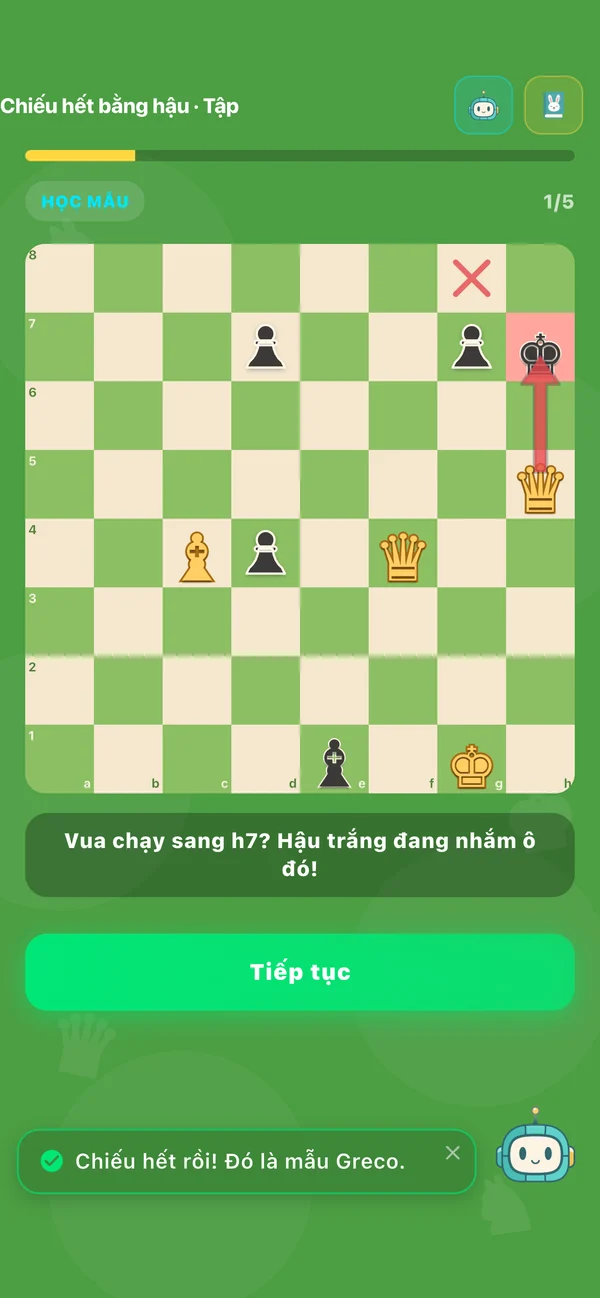
Instructions and comments can be read out loud in 13 languages, including Vietnamese, so children who can't read well can still learn on their own. The app has no ads and no chat with strangers.
About price: every day your child can learn a reasonable amount of lessons for free; When the turn ends, Thỏ Bông will see you tomorrow. The Premium package offers unlimited lessons every day, and is a one-time purchase, lifetime use, not a subscription, no recurring deductions.
Points to consider: Karotto focuses on studying and practicing according to lessons, not platform for children to compete online with others. Children who want to play with real people should play on a chessboard at home, at the club, or use an online platform with safe settings.
2. ChessKid: chess platform specifically for children
Suitable for: children who already know the rules, want to learn and play online in a children's environment.
ChessKid is Chess.com's chess platform for children. The platform has lessons, videos, quizzes, and online play designed to be safe for kids. The pricing model is a paid subscription plan, in addition to a limited free account. Most of the content is in English, so for young Vietnamese children, parents often need to sit with them. Check current prices and packages directly on ChessKid's site.
3. Lichess: free, open source
Good for:older children, well-read readers, or families who want a completely free tool for puzzle practice and play.
Lichess is free, open source, and ad-free. There is a basic lesson on how pieces move and lots of quizzes. However, the interface is made for adults, has a lot of text, and does not have a step-by-step roadmap for children. The platform has chat when playing online, so parents need to go to settings to turn off chat or turn on children's mode before giving the device to their children.
4. Chess.com: the largest chess platform
Suitable for: older children who are good at chess, want many lessons and puzzles, often used with parents.
Chess.com is the largest online chess platform, with many lessons, puzzles, game analysis tools. There is a free version and paid subscription packages. Because it is a common community for all ages, parents should consider ChessKid for young children, or manage their own account and settings if they use Chess.com.
Quick comparison table
The table below summarizes the 5 criteria above. The "Need to check" box means we're not sure or the feature may change, parents should review before choosing.
| Criteria | Karotto | ChessKid | Lichess | Chess.com |
|---|---|---|---|---|
| Easy to difficult roadmap for children | Yes, 6 Steps, 283 lessons, practice test at the end of Step | There are lessons by level | There are basic lessons, no guidance long | Many lessons, designed for all ages |
| Voice for children who cannot read yet | Yes, 13 languages, Vietnamese available | Need to check | Mainly text | Need to check |
| Explain why it's wrong, why it's right | Yes, the chess board shows the consequences and reasons | There are lessons, video explanations | Quiz shows right and wrong, with analytics | Lessons, analytics tools available |
| Chat with strangers | None | Children's environment | Yes, parents need to turn it off | Yes, parents need to manage |
| Advertisement | No | Need to check | No | Available in free version |
| Price model | Free per day; Premium one-time purchase for life | Free with limitations; paid membership | Completely free | Free with limitations; members pay in installments |
So which app should you choose for your child?
No matter which app you choose, don't let the app completely replace the real chess board. Keep it short every day as suggested in the article Chess exercises for children: 15-minute practice schedule every day, and play a few games with your child on a real chess board on the weekend. If your child does not yet know the rules, start from Guide to playing chess for children. For an overview, see Chess for children: a guide from A to Z.
A quick test: let your child use the app for 3 sessions, 15 minutes each session. Then ask your child "What did you learn today?". If your child can recite a specific chess trick, that app is doing its job well.
In short
A good chess learning app for your child is one that guides your child step by step, can talk to your child when he or she is not yet fluent in reading, explains errors instead of indicating errors, is safe for the child to use on his or her own, and has a way to calculate the cost so that the parent does not have to pay for the months the child does not know. learn.
Frequently asked questions
Are free chess learning apps enough for children?
For beginners, free versions of many apps are enough to learn the rules and solve puzzles. What needs to be seen is whether the app has a roadmap from easy to difficult and explains errors. If your child studies regularly and needs more lessons, then consider paying.
Should you choose a one-time purchase app or a monthly subscription?
Monthly or yearly subscriptions automatically deduct money each period, including months when your child is busy taking exams or not studying. Buy once, pay once and use for a long time. For children, the pace of learning often fluctuates with the seasons, so buying at once is often easier to control costs.
Can a 5-year-old child who can't read use a chess app?
Yes, if the app reads the instructions and comments out loud. If the app only has text, parents need to sit next to it to help read it. This is the first criterion that should be checked for children under 7 years old.
How can children play chess online safely?
Prioritize apps or platforms specifically for children, turn off chat with strangers in the settings, use accounts managed by parents and place the device in a common place in the house. For young children, learning and practicing lessons in a chess learning app is enough, no need to play with strangers.
Try Karotto with your child
6 Step chess roadmap, Vietnamese voice, no ads. Learn for free every day; Premium buy once and use for life.
Download on App Store → Download on Google Play →