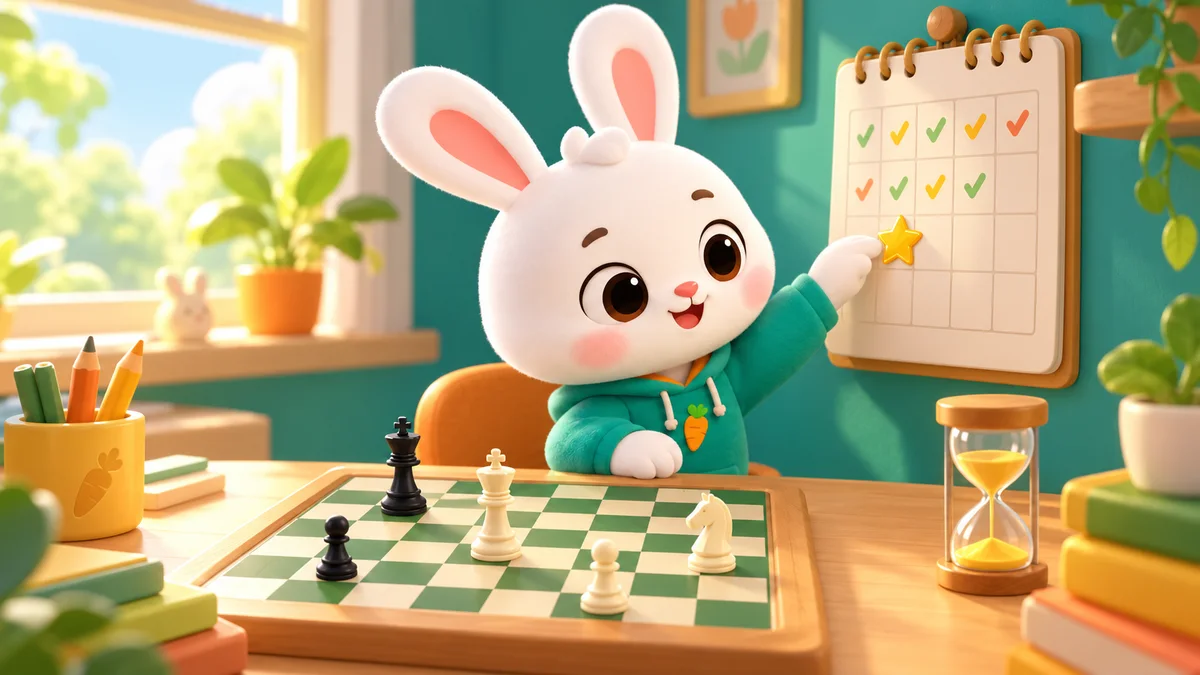
Many children have finished learning The way the pieces move is stagnant: every game you play, you lose the queen, or you have the opportunity to checkmate but don't see it. The reason is usually not that the child is weak, but that the child has not met enough "patterns" of the flag. Good chess players recognize moves quickly because they have seen similar positions hundreds of times.
The good news is that it doesn't take much time. 15 minutes a day, regularly, is enough for your baby to make clear progress after a few weeks.
Chess practice schedule 15 minutes per day: week sample
A good training week has three types of activities: solving exercises (training your eyes to see blows), playing short boards (using blows in real situations) and review the game (learn from mistakes). The calendar below is a suggestion, parents can change the days to suit their family routine.
For children 5–6 years old, you can reduce it to 10 minutes and skip one day. For children 9–11 years old who are interested in chess, you can increase it to 20–30 minutes, but still maintain the structure of three types of activities as above.
How to choose chess exercises that are suitable for your child?
Simple rule: your child should solve about 7–8 correctly out of 10 article. It's true that the lesson is too easy and the child is bored. If you get more than half wrong, the card is too difficult, your child gets frustrated and starts guessing.
- Just learned the rules: "taking an unprotected piece", "escape check", "checkmate 1 move".
- Have played a few dozen games: attack card Double attack, pin, checkmate 2 moves.
- Familiar with single attacks: Multi-step combination exercises such as opening check, seduction.
Each session should focus on one topic. Ten "paired code" exercises in a row help your baby remember the pattern better than ten jumbled exercises. If it's unclear which stage your child is in, the lesson Kids learn chess at home: 6-stage roadmap has a list of signs for each stage.
Golden habit: before each move, your child asks three questions "Is there a mat? Can you eat anything?" What are you threatening?". These three sentences solve most of the errors of losing pieces of new children.
Who should children play chess with?
With parents
Even if parents are not good at chess, a game of chess with their children is still very valuable. If the parents are stronger, accept a piece (for example, give up your queen) instead of deliberately making a mistake. The child will win "for real" and learn how to take advantage.
With friends of the same level
This is the most fun and beneficial type of game: two children are equal, everyone has a chance to win. A classmate or cousin is an ideal match.
With the machine on easy
The machine is always ready and doesn't tire, but choose the low level. A machine that is too powerful will "crush" your baby after just a few moves, and your baby won't learn anything except the feeling of losing. Choose a level where your child wins about half of the games.
When should you enter your child in a mini tournament?
Tournaments are a great experience, but there's no need to rush them. Your child is ready when:
- No longer violates the rules, knows when he is check and knows castling, promotion.
- Can sit for a full game for 20–30 minutes and still concentrate.
- If you lose a game, don't cry for too long, and still want to play the next game follow.
Start with small tournaments at clubs, cultural houses or schools, divided by age groups. The goal of the first tournament is to "play all the games and have fun", not to win a medal.
Reviewing the lost game: how to make your child not sad
Reviewing the game is the best habit to improve, but it can also easily make your child feel bad if done the wrong way. Suggestion:
- Wait for your child to calm down. Don't analyze right away when your child has just lost. Leave it until the evening or the next day.
- Let your child tell first. "When do you think the chess game starts to get difficult?" Children can usually point it out themselves.
- Find only one move. One most important failed move, don't list ten mistakes.
- Find alternative moves together. Re-present the chess position, try 2–3 options, see which option keeps the pieces.
- End with what the child does well. "The first part of the child's play is very beautiful."
3 chess exercises for children (with answers)
Place the chess positions below on a real chess board for your child to solve. All three are turns White goes. Let your child think for at least a minute before opening the answer. If you need to review how to read the cell names (columns a–h, rows 1–8), see Guide to playing chess for children.
Lesson 1: checkmate in 1 move
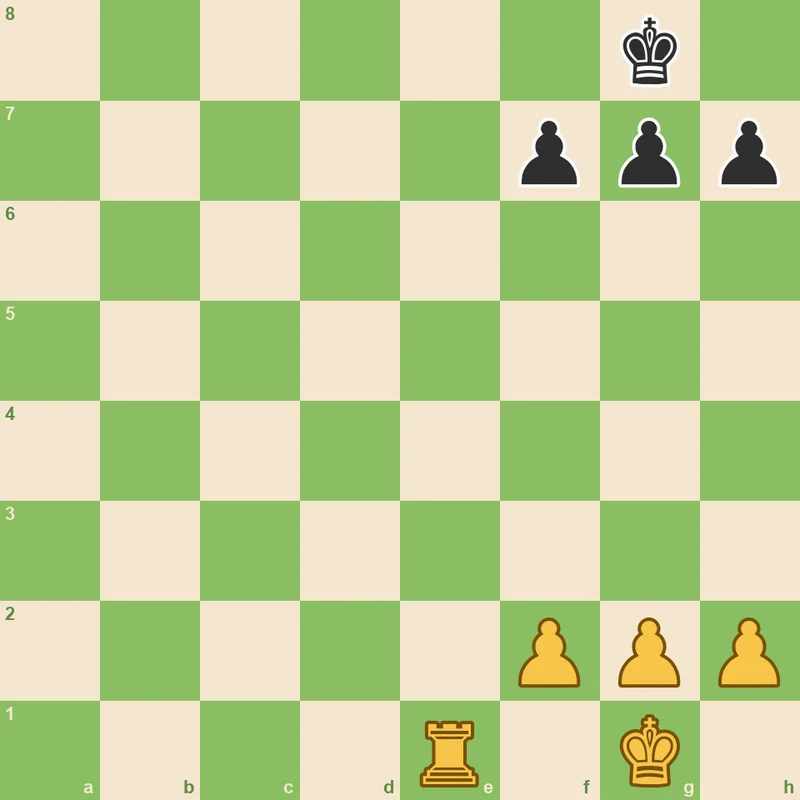
White: King g1, Rook e1, Pawn f2, g2, h2. Black: King g8, Pawn f7, g7, h7. White moves and checkmate in the same move.
See answer
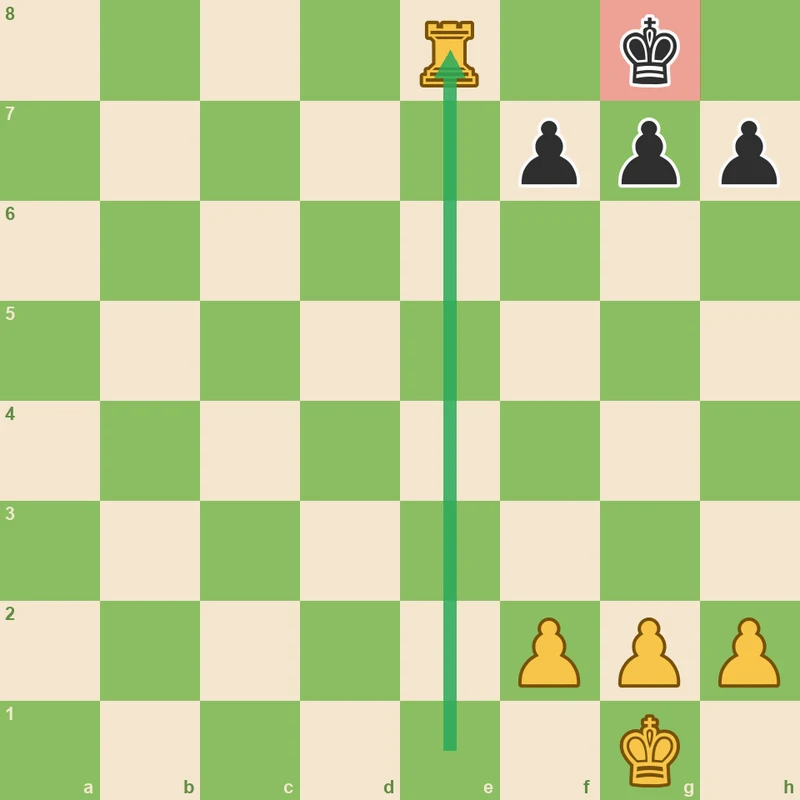
Rook e1 goes to e8. Column e has no pieces blocking it, so the rook goes straight to the last row, checking king g8. Black King cannot escape: squares f7, g7, h7 are occupied by his main pawn, while f8 and h8 are on row 8 that the rook is controlling. No black army can take the cart or get in the middle. This is the classic "checkmate last row" pattern. Parents can read more in the lesson Check, checkmate and special rules.
Lesson 2: Knight pairs
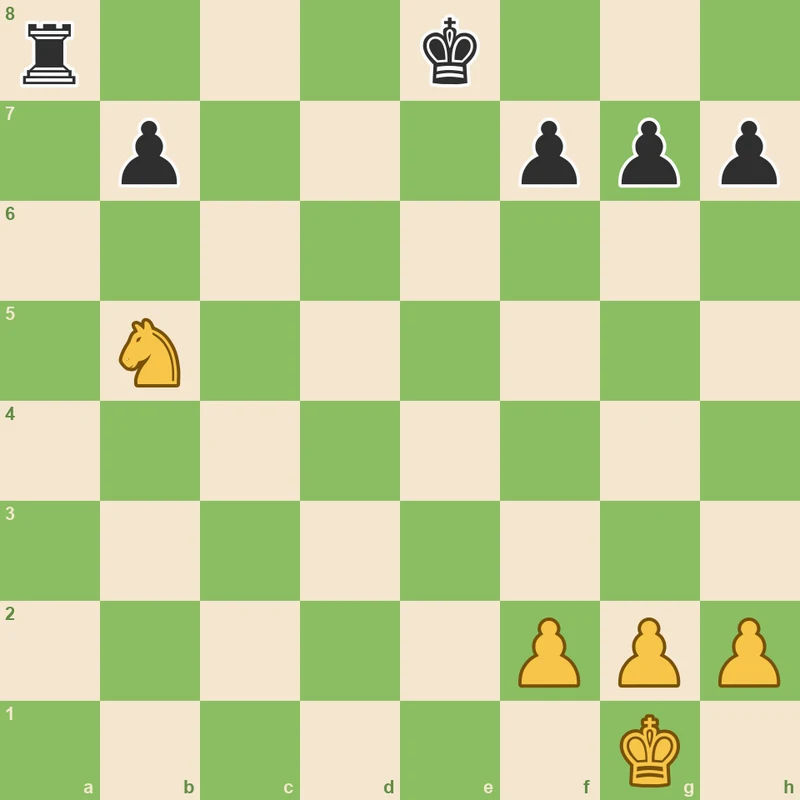
White: Knight b5 (White King stands far away, does not participate). Black: King e8, Rook a8. Find a move that will help White capture black Rook.
See answer
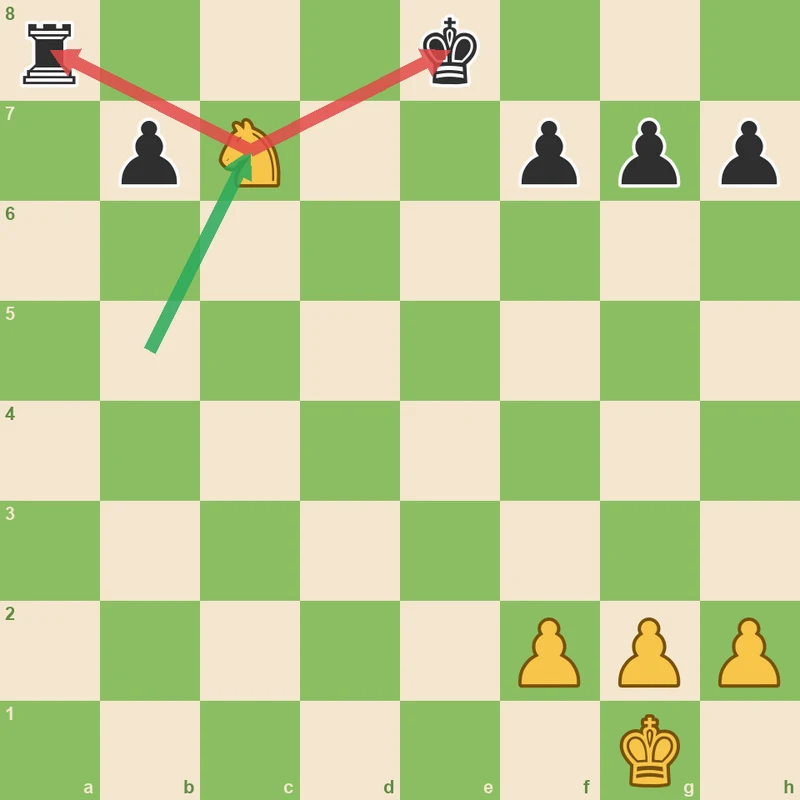
Knight b5 jumps to c7. From c7, the knight controls both e8 (checking the king) and a8 (aiming the rook). Black is in check so he must take care of the king first. King e8 cannot take the knight because c7 is not close to the king, and rook a8 cannot take c7. Wherever King runs, White's back move will also use the rook code a8. This is a "double attack", one of the first moves your child should know.
Lesson 3: Which card is safe to play?
White: King g1, Rook d1, Knight f2. Black: Knight d5 (protected by pawn e6), Bishop g4 (no piece to protect, again aiming rook d1 diagonally g4, f3, e2, d1). Which piece does White take?
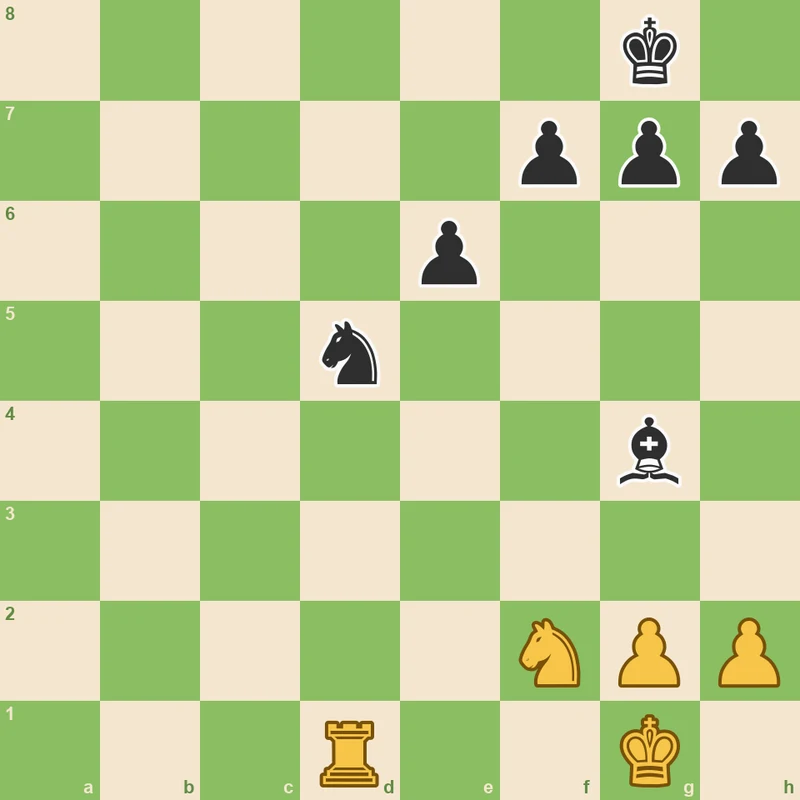
See answer
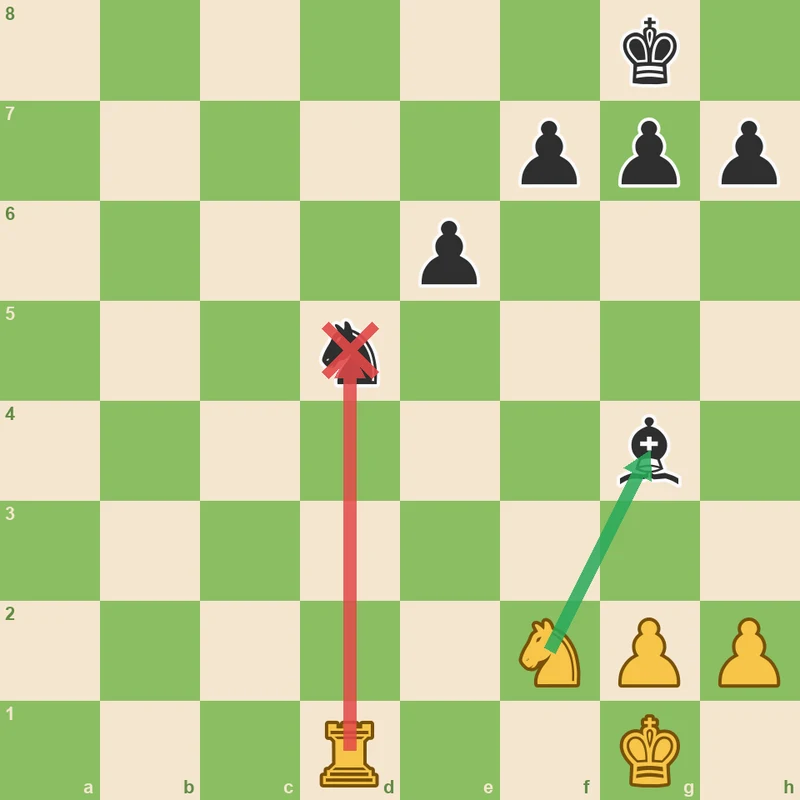
Knight f2 takes bishop g4. Bishop g4 has no one to defend, so White wins a whole piece. This move also has an additional advantage: the bishop is aiming at rook d1, if you take the bishop, the rook will no longer be threatened.
The trap here is Rook d1 eats knight d5. It looks attractive, but if it's good, e6 will cross right away. White loses his rook (piece worth about 5 pawns) in exchange for his knight (about 3 pawns), a big loss. Lesson: "protected" pieces must be counted carefully before taking; "Unprotected" troops are safe food.
Practice exercises on Karotto
Transparency: Karotto is the app of the team that makes this website. In Karotto's Chess course, each topic such as checkmate, double attack code or safe piece capture has a "Sample study" section and then a "Practice" section for children to learn on their own. There are also "Chess without hints" lessons: the chess board does not show arrows, the child must see the moves himself like when playing for real. At the end of each Step, there is a Review lesson and a 20-question practice test.
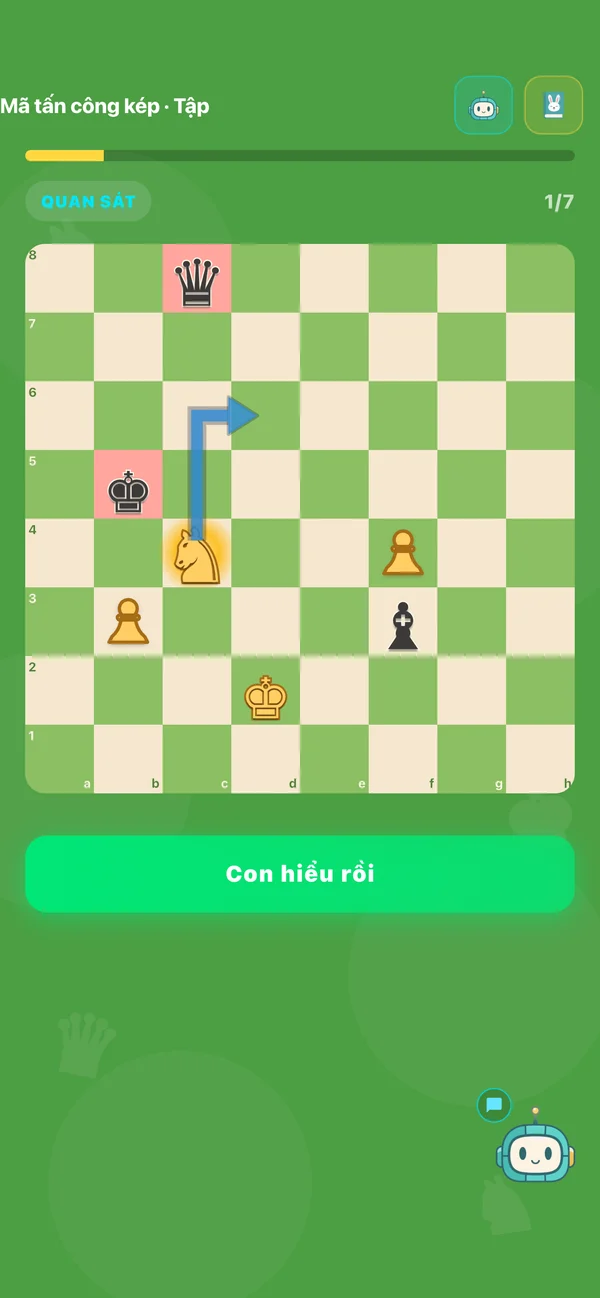
When the child makes a mistake, the chess board shows the consequences so the child understands why it is wrong, instead of just indicating "wrong". The instructions are read out loud in Vietnamese, so children who are not fluent in reading can still practice on their own.
Every day children can learn a suitable amount of lessons for free; At the end of the turn, Thỏ Bông makes an appointment for tomorrow, matching the "15 minutes a day" rhythm of this song. If your child wants to practice unlimitedly, the Premium package is a one-time purchase, lifetime use, not a monthly or yearly subscription.
In short
Children improve in chess by practicing little but evenly: moderate exercises according to topic, game short to use, and review a bad move every week. Start with the 3 exercises above, then keep the rhythm for 15 minutes a day.
Frequently Asked Questions
Is 15 minutes a day enough for your child to improve at chess?
Enough for the first stage, if practiced regularly. 15 focused minutes a day with moderate exercises is often more effective than one long session a week, because your child sees the chess patterns more often and remembers them longer.
What if your child keeps getting the exercises wrong?
That's a sign the lesson is too difficult. Let's move back to a slightly easier form, for example checkmate 1 move instead of 2 moves. Your child should solve about 7 or 8 out of 10 problems correctly to be comfortable.
Should your child play chess with the computer?
Yes, but choose an easy level so your child has a chance to win and try new ideas. The machine is too strong and can easily frustrate your baby. Should be interspersed with real chess games with people so that the child gets used to sitting opposite and waiting for turns.
When should the child participate in the first chess tournament?
When the child firmly grasps the rules, no longer breaks the rules, plays a full game for about 20-30 minutes while still focusing, and accepts losing. You should start with small tournaments at clubs or schools, suitable for age groups.
Practice 15 minutes a day with Thỏ Bông
Chess exercises from easy to difficult, with Vietnamese voice and explanations of why it's right and why it's wrong.
Download on App Store → Get on Google Play →