Many parents want to find an activity that helps their children “think well” more". The important thing is not to let your child do a lot of exercises or download a lot of apps. An effective activity needs to force children to stop, predict, try things out, recognize mistakes and explain why they changed direction.
Here are five ways that can be combined during the week. Each way trains a different part of thinking.
1. Do math on paper and with real objects
Math: reasoning, number sense, presentation, and perseverance.
Math doesn't have to be about long worksheets. Children can divide the cake for the whole family, count money when playing shop, stack counting sticks to find many ways to create the same number, and then record the calculation. When children write, cross out, draw diagrams or move objects, they see their own thinking process.
Why shouldn't you just learn math on the iPad? The screen gives quick feedback, but it's easy for your child to choose the answer or try clicking instead of showing the way. With new math problems, paper and real objects help children slow down, draw their own pictures, record intermediate steps and come back to check. iPads can be used for a few short review lessons, but should not replace doing math by hand.
2. Learn programming through targeted exercises
Forge: break down problems, think sequentially, predict and fix errors.
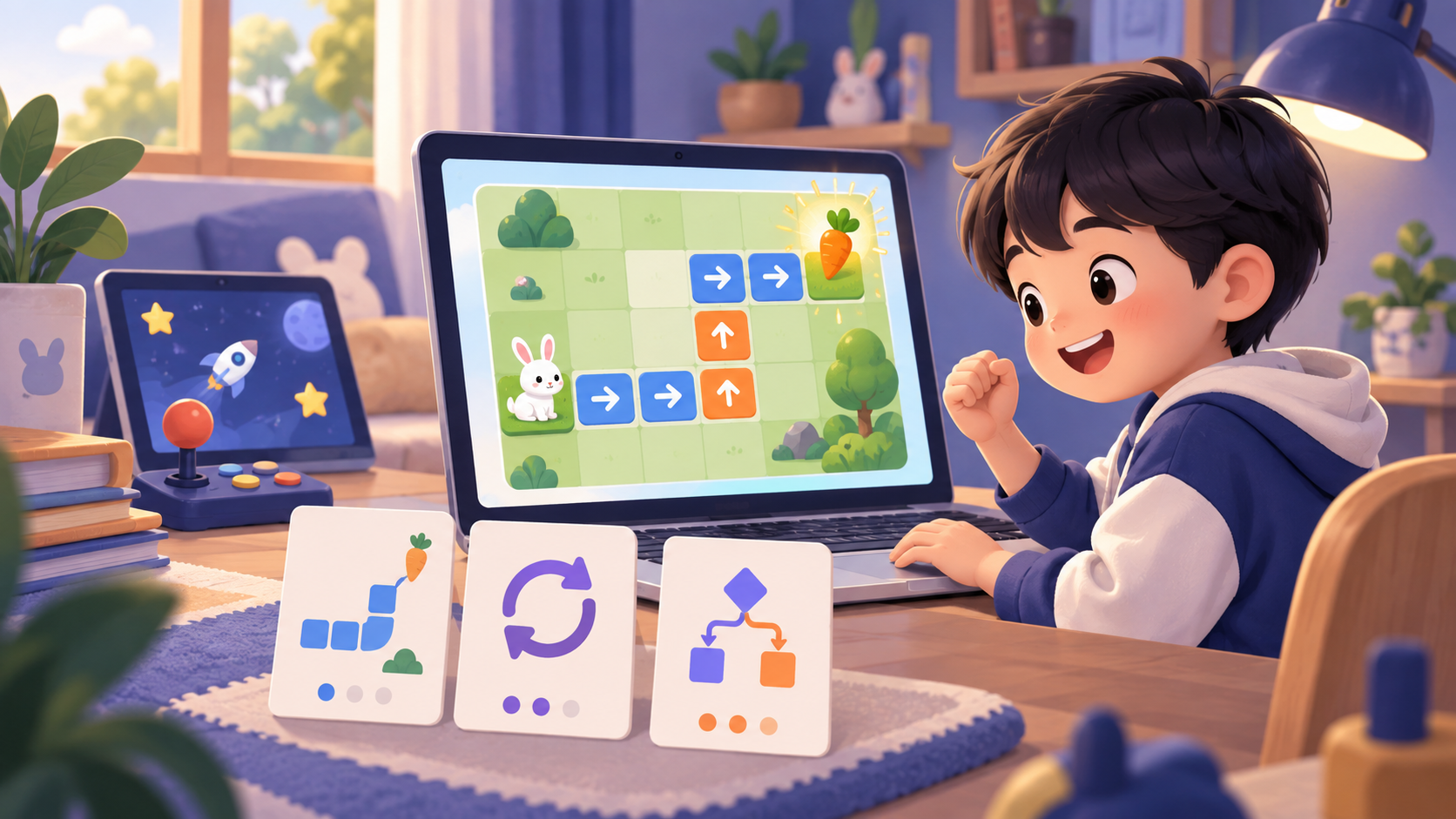
Programming is effective when your child has a specific goal, such as bringing a character to the destination with a limited number of commands, using loops to shorten the solution or finding errors in a sequence of commands. Children have to think "which command runs first?", "If you do it this way, what will happen?" and "Why is it not correct?".
Therefore, prioritize apps with clear roadmaps and objectives for each lesson. Challenges should gradually increase from sequences to loops, conditions and functions, instead of letting your child just click and play freely. After each lesson, a simple question like “where did you correct?” Help your baby turn experience into understanding.
3. Play puzzle games, but think of them as supplements
Forge: observe, test, and predict cause–effect relationships.
Games like Where’s My Water? or Cut the Rope can be very engaging. Children observe water lines, gravity, ropes and try many options to achieve their goals. They are useful for arousing curiosity and showing children that changing one detail can create a different result.
But only part of it can be trained. Games often divide challenges into short stages, with hints and immediate rewards. Children can pass a test by trial and error without having to express a plan, write down how to do it, or build skills according to a curriculum. Therefore, do not consider puzzle games as the main method of learning thinking; Use 10–15 minutes as a warm-up or reward, then ask your child: “What do you predict will happen before you touch the screen?”
Why might a programming game like Karotto be more suitable than a regular puzzle game? Karotto retains the feeling of play: characters, challenges, and instant feedback Drag and drop commands. But each level is designed around a specific thinking problem — a sequence, loop, condition, or function — and follows each other as a roadmap. The goal is for your child to focus on finding the solution, understanding why the solution is correct, and self-correcting when they are wrong, instead of just trying to pass the level or collect rewards.
Many games on the market are optimized to keep players staying longer: constant rewards, items, new levels, or invitations to buy more can make it difficult for children to stop. That doesn't mean all games are bad, but parents should always ask: "After 15 minutes, what skill did your child just practice?" With Karotto, the measure should be which math problems the child has understood and solved, not how long the child has been playing.
4. Playing board games and puzzles without a screen
Training: planning, working memory, communication and understanding the rules of the game.
Checkers, simple chess, puzzles, Sudoku for children, tangrams or pattern finding all create a type of thinking that is slower than a screen. Children need to remember the rules, wait their turn, look a few steps ahead and talk to their partner. Changing your mind or losing a game is also a good opportunity for your child to learn how to review their strategy.
No need to buy a complicated game set. You can use homemade number cards, ice cream sticks, shirt buttons or a piece of square paper to create a game to find the rules for the whole family.
5. Give your child small "life problems"
Forge: ask questions, organize, estimate and make decisions.
Let your child make a list of things to buy with a small budget, choose the order to make breakfast, figure out how to pack a suitcase, or plan a trip from home to the park. Instead of saying the answer, parents can ask: "What will you do first?", "What if one item is missing?", "Is there a way with fewer steps?".
This is thinking in a real context: the child sees the consequences of his decision, then adjusts next time. No app can completely replace this experience.
A balanced week can start very small
For example: 2–3 math sessions on paper or real objects; 2 targeted programming sessions; 1–2 times short puzzle games; and board games or daily life problems. What needs to be tracked is not the number of minutes on the app, but whether the child is predicting, explaining and correcting his own work.
Coding as a thinking session
Karotto takes children through drag-and-drop challenges with clear goals, helping them practice thinking step by step instead of just playing through levels.
View Karotto on the App Store →