Parents looking for math olympiad practice usually hit the same two problems: random past papers that do not show which problem type a child is weak at, and answer keys without explanations. This collection sorts TIMO-style problems by type. Each type has problems for grade 1, grade 2 and grade 3, from easiest to hardest, and the last page of every file is an answer key with a short worked solution for each problem.
All problems were written by the Karotto team in the style of common math olympiad questions. They are not official exam papers, and Karotto is not affiliated with the TIMO organisers. New to the competition? Read What is TIMO? first.
Mixed TIMO practice packs by grade (PDF)
Each pack has one problem of every type for that grade, grouped into the 5 strands, like a full practice paper. Answers and solutions are at the end.
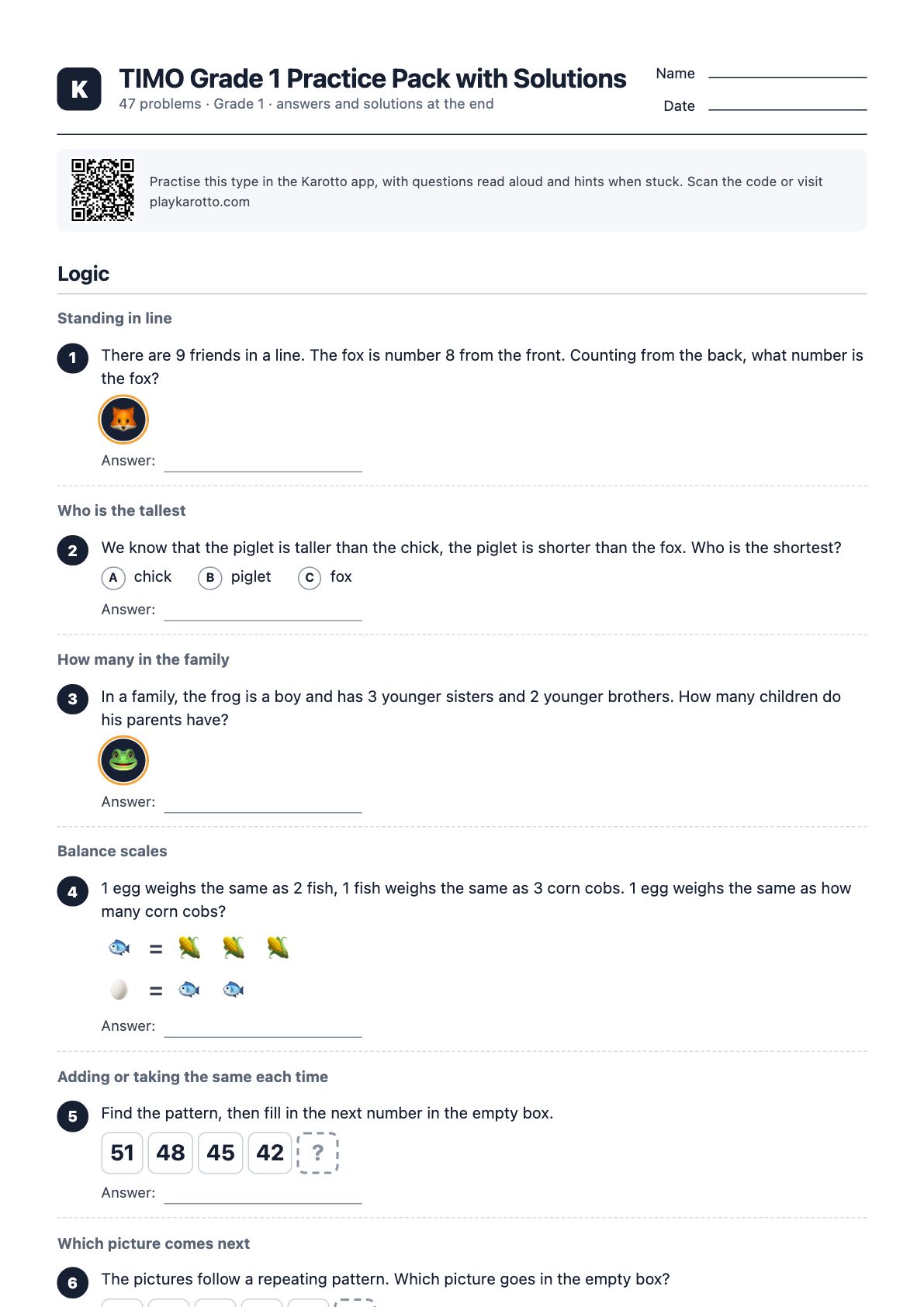
TIMO Grade 1 Practice Pack with Solutions
View PDF Download PDF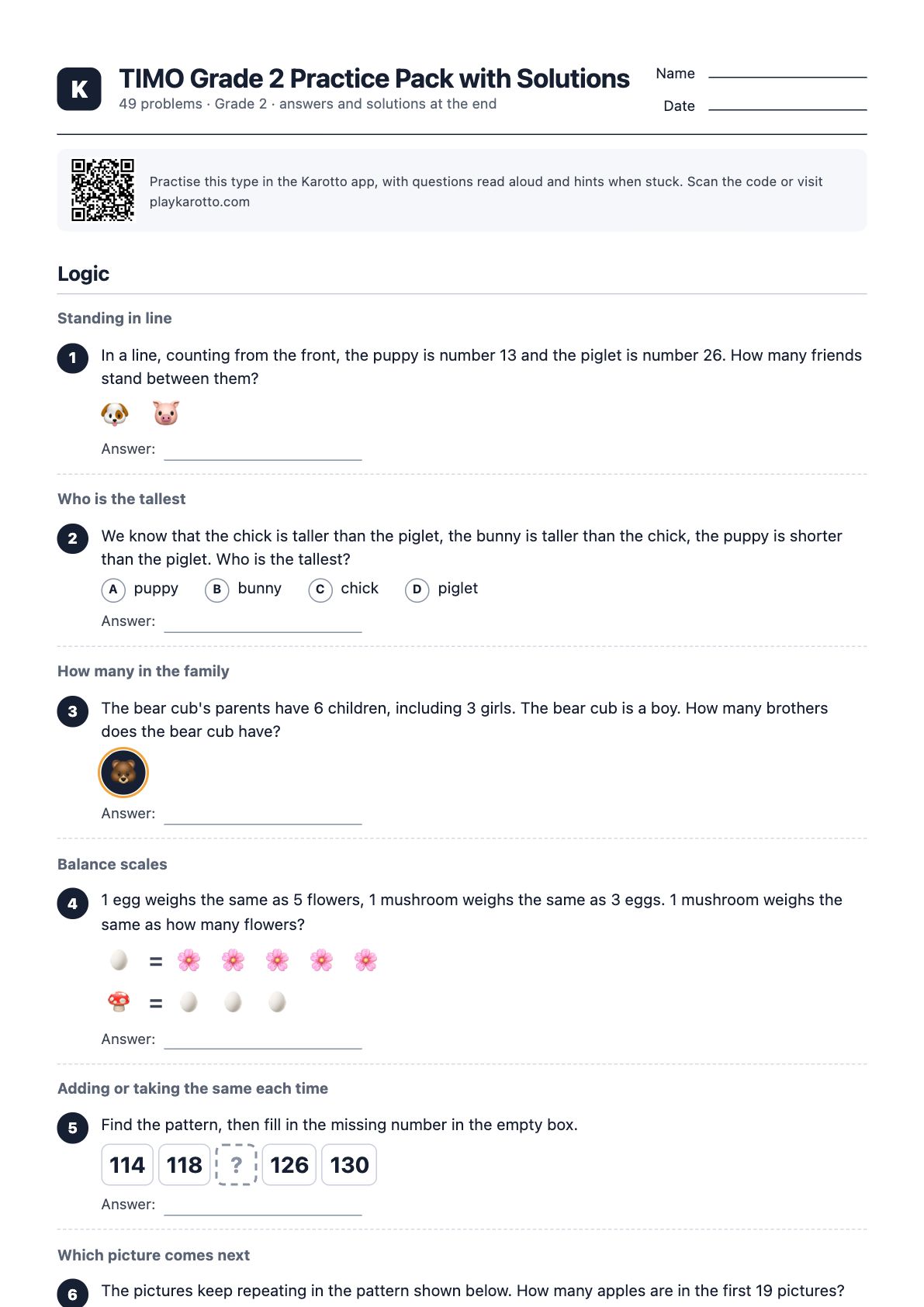
TIMO Grade 2 Practice Pack with Solutions
View PDF Download PDF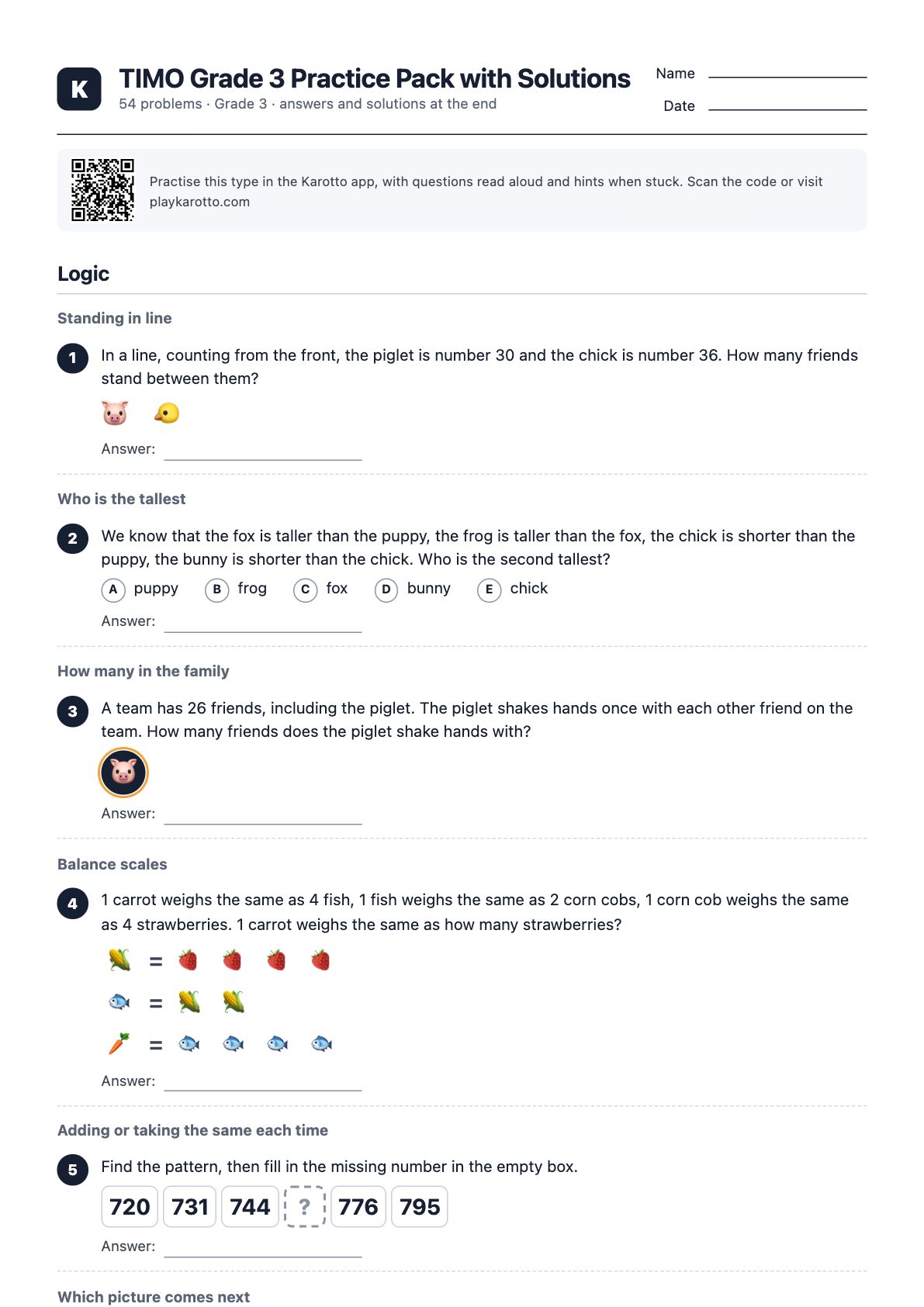
TIMO Grade 3 Practice Pack with Solutions
View PDF Download PDFAll TIMO problem types (PDF worksheets with solutions)
Tap a strand to see a worked example and a solving tip for each type, or open the PDF of the type your child needs.
Logic
Line-up puzzles, taller and shorter, family riddles, balance scales, picture and number patterns, calendar questions and code breaking. Children learn to read every condition carefully and work out what the problem does not say directly.
Arithmetic
Quick sums by pairing, missing numbers, pictures that stand for numbers, age problems, counting chicken and dog legs, fence posts, sharing until equal and letter sums. This is the biggest strand in most math olympiad papers.
Number Theory
Counting numbers in a range, odd and even, tens and ones, the nth term of a sequence, counting digits, making numbers from digits, digit sums, divisibility and remainders. Children learn to list in order so nothing is missed or counted twice.
Geometry
Counting squares, triangles, rectangles, line segments and cubes; edges and corners; matchstick patterns, cutting a cake and the perimeter of joined shapes. The key habit: count the small shapes first, then the bigger ones.
Combinatorics
How many ways to choose, how many numbers can be made, handshakes, counting paths, making change with coins and picking marbles to be sure (the pigeonhole principle). Children learn to list with a table or a tree.
How to get the most out of these worksheets
- One type per session: pick a type and do the 4 problems for your child's grade. Stay with one way of thinking before moving on.
- Explain first, check second: ask your child to tell you how they solved it before you turn to the solutions. If an answer is wrong, find the exact step that went wrong.
- Redo mistakes the next day: one problem fixed properly beats three done in a hurry. Once your child gets 3 of 4 right, move up to the next grade's problems.
Keep practising these types in the Karotto app
In the app every problem type above is a lesson with the question read aloud, three levels of hints when your child is stuck and a step-by-step solution. Problems are generated fresh, so every attempt is a new set.
Frequently asked questions
Are these real TIMO exam papers?
No. Every problem was written by Karotto in the style of common TIMO-type math olympiad questions. Karotto is not affiliated with the TIMO organisers. For official papers, please contact the competition organiser.
Are the PDF worksheets free?
Yes, completely free. Parents and teachers may print them as often as they like for home or classroom use. Please share a link to this page rather than re-uploading the files.
Can I trust the answers?
The problems come from the Karotto app's problem generator, and every type is checked by an independent solver. Shape-counting problems are checked by brute force over the coordinates of every line segment.
Which type should my child start with?
Start with the strand your child finds easiest, usually Logic or Arithmetic, to build confidence. Inside each file the grade 1 problems come first and grade 3 last, so your child can simply stop where it gets too hard and continue another day.