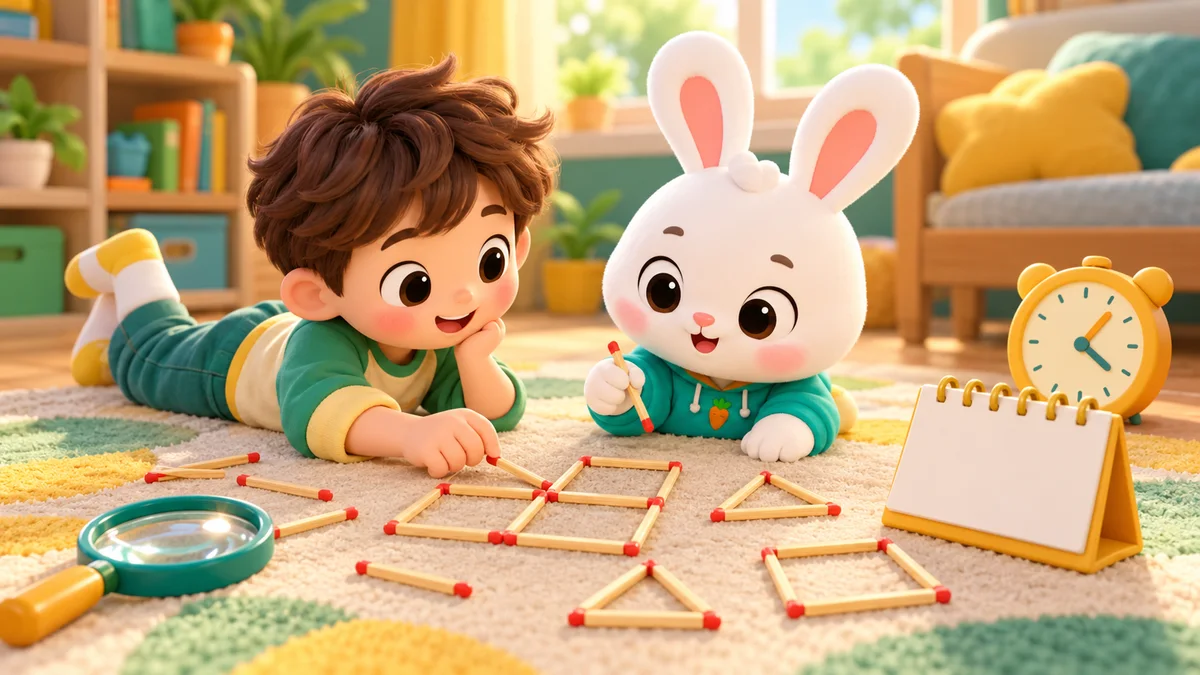
Counting squares, triangles, rectangles, line segments and cubes; edges and corners; matchstick patterns, cutting a cake and the perimeter of joined shapes. The key habit: count the small shapes first, then the bigger ones.
Counting squares
Solving tip: Count the small 1-box squares first, then the 4-box squares, the 9-box squares…
How many squares are there in the picture in all?
Show solution
Answer: 11
How to think: Count the small 1-box squares first, then the 4-box squares, the 9-box squares…
Solution: Count from small to big: 8 plus 3 equals 11 squares.
Counting triangles
Solving tip: Count the 1-part triangles first, then the triangles made of 2 parts, 3 parts…
How many triangles are there in the picture in all?
Show solution
Answer: 3
How to think: Count the 1-part triangles first, then the triangles made of 2 parts, 3 parts…
Solution: Count the triangles of 1 part, 2 parts, 3 parts…: 2 plus 1 equals 3 triangles.
Counting line segments
Solving tip: Count in order: the segments starting at the first point, then the ones starting at the second point, and so on.
The picture has 5 points on one straight line. How many line segments are there in all?
Show solution
Answer: 10
How to think: Count in order: the segments starting at the first point, then the ones starting at the second point, and so on.
Solution: Count the segments starting at each point: 4 plus 3 plus 2 plus 1 equals 10 segments.
Counting rectangles
Solving tip: Count the 1-box shapes, then the shapes made of 2 boxes, 3 boxes…
How many rectangles are there in the picture in all? Squares count as rectangles too.
Show solution
Answer: 6
How to think: Count the 1-box shapes, then the shapes made of 2 boxes, 3 boxes…
Solution: Count the shapes of 1 box, 2 boxes, 3 boxes…: 3 plus 2 plus 1 equals 6 shapes.
Counting cubes
Solving tip: Count column by column, and remember the hidden cubes underneath.
How many cubes are in the picture? A cube on top always has a cube under it.
Show solution
Answer: 8
How to think: Count column by column, and remember the hidden cubes underneath.
Solution: Add up the cubes in each column: 1 plus 1 plus 2 plus 1 plus 1 plus 2 equals 8 cubes.
How many sides and corners
Solving tip: Go around the shape and count every place where the edge turns, including the corners that point inward.
How many corners does the shape have?
Show solution
Answer: 8
How to think: Go around the shape and count every place where the edge turns, including the corners that point inward.
Solution: 6 corners pointing out plus 2 corners pointing in equals 8 corners.
Matchstick shapes
Solving tip: The first square needs 4 sticks. Each next square shares 1 stick with the one before it.
Making 2 squares in a row like in the picture takes 7 matchsticks. How many matchsticks do you need for 6 squares in a row like this?
Show solution
Answer: 19
How to think: The first square needs 4 sticks. Each next square shares 1 stick with the one before it.
Solution: The first square needs 4 sticks, and the 5 squares after it need 3 more each: 4 plus 5 times 3 equals 19 sticks.
Cutting cakes, drawing lines
Solving tip: The first cut makes 2 pieces. How many more does each new cut add?
You cut a round cake with 4 straight cuts, and every cut goes through the middle. How many pieces do you get?
Show solution
Answer: 8
How to think: The first cut makes 2 pieces. How many more does each new cut add?
Solution: Each cut through the middle gives 2 pieces. 4 cuts give 2 plus 2 plus 2 plus 2, which is 8 pieces.
Perimeter of joined shapes
Solving tip: The perimeter is the length all the way around the outside of the shape. Lines inside don't count.
2 squares, each with sides of 5 centimetres, are put together in a row like the picture. What is the perimeter of the new shape in centimetres?
Show solution
Answer: 30
How to think: The perimeter is the length all the way around the outside of the shape. Lines inside don't count.
Solution: The new shape is a rectangle 10 centimetres long and 5 centimetres wide. The perimeter is 10 plus 5 plus 10 plus 5 equals 30.
Keep practising these types in the Karotto app
In the app every problem type above is a lesson with the question read aloud, three levels of hints when your child is stuck and a step-by-step solution. Problems are generated fresh, so every attempt is a new set.