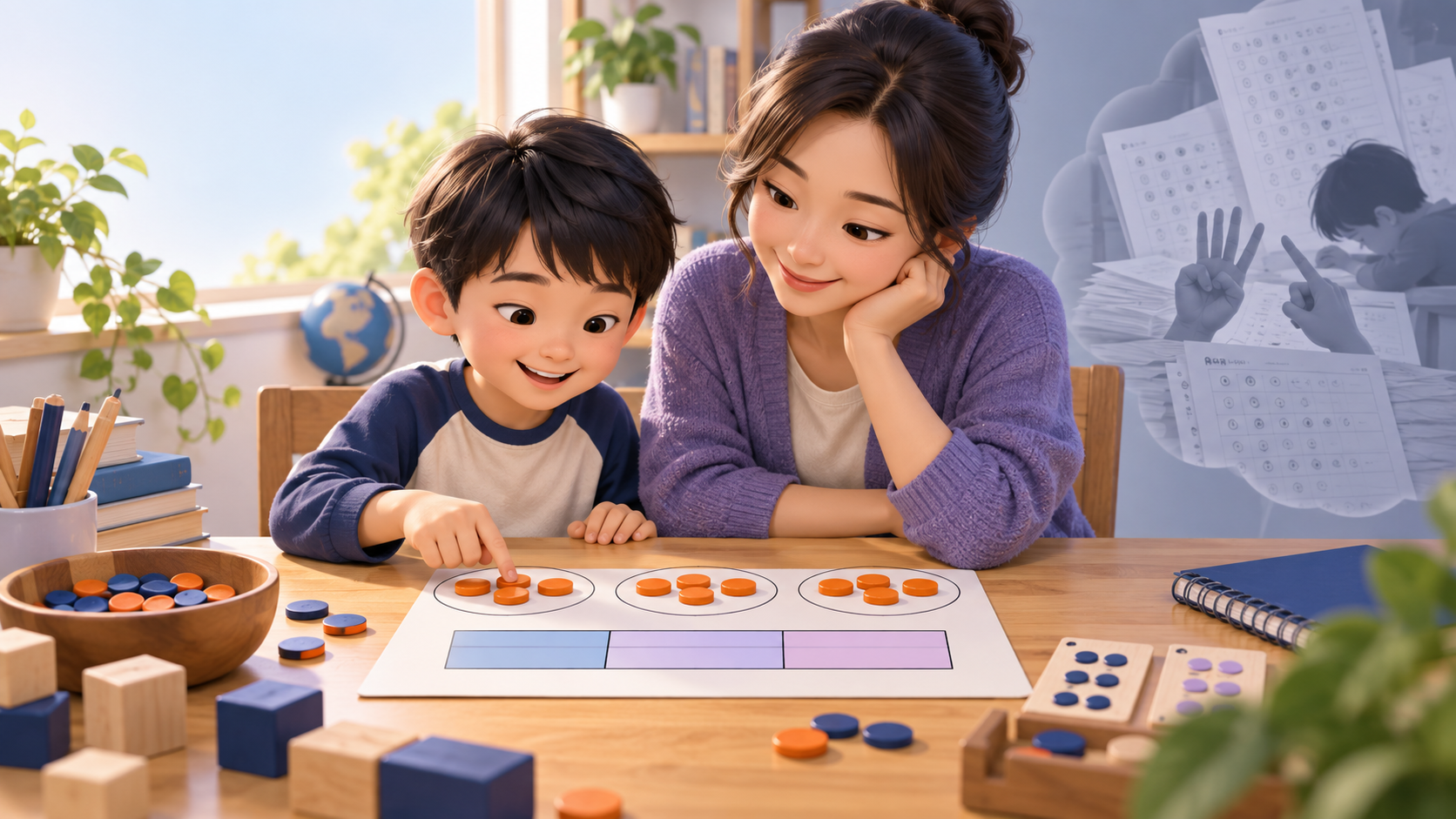
“Mental math” is a very broad label. Some places use it for logic problems, others for speed mental arithmetic, abacus, fingers, Singapore Math or Montessori. Therefore, what should be evaluated is not the name of the program but the child's learning experience: can the child manipulate, draw/perform, express thoughts and gradually use symbolsmanipulate, draw/represent, speak out thoughts and gradually use symbols?
Criteria of this review: a method worth following Should help children understand the relationship between quantities, images, symbols and real situations; Allow your baby to try many strategies; and don't make calculation speed the only measure.
First of all: using your hands is not bad — memorizing hand operations is the problem
Fingers, sticks, buttons, wooden blocks or abacus can all be good tools for children to see numbers. Education Endowment Foundation guidelines state that manipulative objects, including fingers, can help children build math ideas; The key is for adults to connect the tool with mathematical meaning, drawings, and symbols. See EEF instructions.
Therefore, we do not recommend choosing classes that take finger manipulation or calculation speed as the goal: the child is taught a fixed sequence of movements, reading the results, but for some reason 8 + 7 may be thought of as 8 + 2 + 5 or draw the corresponding situation. Then the child can correctly calculate a familiar form but is confused when the number, question or context changes.
Proper usage: let the child use his hands to separate 7 into 5 and 2, then draw 5 dots + 2 dots, say “7 consists of 5 and 2”, finally write 5 + 2 = 7. The tool should be the bridge to reach. understanding, is not a crutch that must be used forever.
1. Singapore Math / CPA: the priority if you want a solid foundation
CPA is to go from Concrete (real object), to Pictorial (image/diagram), then Abstract (symbol). This is a way that is close to the direction of learning concepts before technology: children divide 12 buttons into groups, draw a part-total diagram, then write the calculation.
Strengths: helps children connect numbers with quantities, use bar models to read word problems and get used to explaining strategies. The Singapore Math curriculum framework places problem solving at the heart, engaging with concepts, skills, processes, metacognition and attitudes. See Singapore's Mathematics Syllabus.
To avoid: buying CPA books and then forcing your child to do pages of worksheets. If there is no part of manipulating, drawing and saying reasons, the good method also turns into regular practice.
Conclusion: should be chosen, especially for elementary school children, if the class spends time on unfamiliar math problems and asking "why?".
2. Montessori Math: very good at the stage of getting used to numbers and quantities
Montessori uses purposeful materials such as beads, number bars, bead boards and Stamp Game for children to manipulate, observe rules and go from concrete to abstract. The American Montessori Society describes this material as a way of translating abstract ideas into real actions and objects, introduced at the child's level of readiness. See Montessori Math documents.
Strengths: suitable for young children, children need to touch - sort - compare to understand quantity, and children need a more independent learning rhythm.
Limitations: Beautiful materials do not create thinking by themselves. Ask the teacher: after your child arranges beads, can he or she draw, speak, and write calculations? Does your child encounter practical math problems outside of the kit?
Conclusion: should be chosen for kindergarten - early elementary school, when the class has a good instructor and has a gradual transition to representation and notation.
3. Kumon and repetition skills practice: use just enough, don't make the main axis
Practice many short exercises that are helpful for remembering arithmetic facts and increasing fluency. Children who quickly know 6 + 7 or the multiplication table will be less overwhelmed when solving larger problems. But fluency is just a component, not a substitute for conceptual understanding or problem-solving strategies.
When to use: after your child has understood the meaning of the calculation and needs 5–10 minutes of limited review. When not to use: when your child gets it right because he knows the format but can't explain it, or when his mood begins to depend on the number of completed pages and speed.
4. Abacus, finger math and speed mental math: should only be additional tools
A real abacus can clarify units, tens and "converting 10 units to 1 tens". Fingers can also help young children represent numbers. However, programs that teach operational formulas to calculate very quickly — especially when asking children to imagine an abacus or make fixed hand movements — have the risk of causing children to learn shortcuts before understanding number relationships.
Signs to stop or not choose: teacher only praises speed; Children cannot draw or choose otherwise; no word problems; The child cannot explain "why"; or the program promises fast calculation as the most important goal.
Conclusion: should not be a core method. If used, use it after the number comprehension part, with a short duration, and always ask the child to connect the operation with quantities, diagrams and calculations.
5. Logical math, puzzles and Olympiads: good for curiosity, should not be forced too early They work best when the child has a reasonable foundation in arithmetic and is allowed trial and error.
Rules puzzles, tangrams, children's Sudoku, open-ended math problems and math exams can train strategy, perseverance and reasoning ability. They work best when your child has a reasonable foundation in arithmetic and is allowed trial and error.
Do not: push the problem beyond capacity to practice "difficult problems", or consider the number of correct answers as proof that the child has thinking. A moderate math problem that the child can explain in two ways is more valuable than a very difficult problem that the child just waits for the answer.
Choose a class with 6 questions
Short conclusion
We prioritize CPA/Singapore Math and Montessori with good instruction, combining a sufficient amount of skill practice and puzzles. We do not recommend classes that make mental arithmetic or abacus manipulation the destination, or programs that only measure speed and number of pages. Good math thinking must help children understand the problem first, then faster.
From mathematical thinking to programming thinking
Representing the problem, breaking down the steps and checking the solution is also the foundation of programming. Karotto helps children practice those skills through drag-and-drop challenges with clear goals.
See Karotto on App Store →