Whether a child learns chess at home or at a club, they need two things: plenty of positions at the right level, and an answer key that explains why the move works, so a parent can help even without being a strong player. There are two ways to use this collection. The level workbooks follow a path from level 1 (complete beginner) to level 6 (self-study and tournaments). The theme worksheets collect a single topic, such as mate in 1 or pins, so your child can practise exactly what they find hard.
The six levels follow the order of skills many chess clubs use, roughly matching Step 1 to Step 6 of the Dutch Steps Method. These worksheets were written by Karotto and are not official Steps Method material. The positions come from the chess course in the Karotto app, and the answers are worked out by the app's move checker.
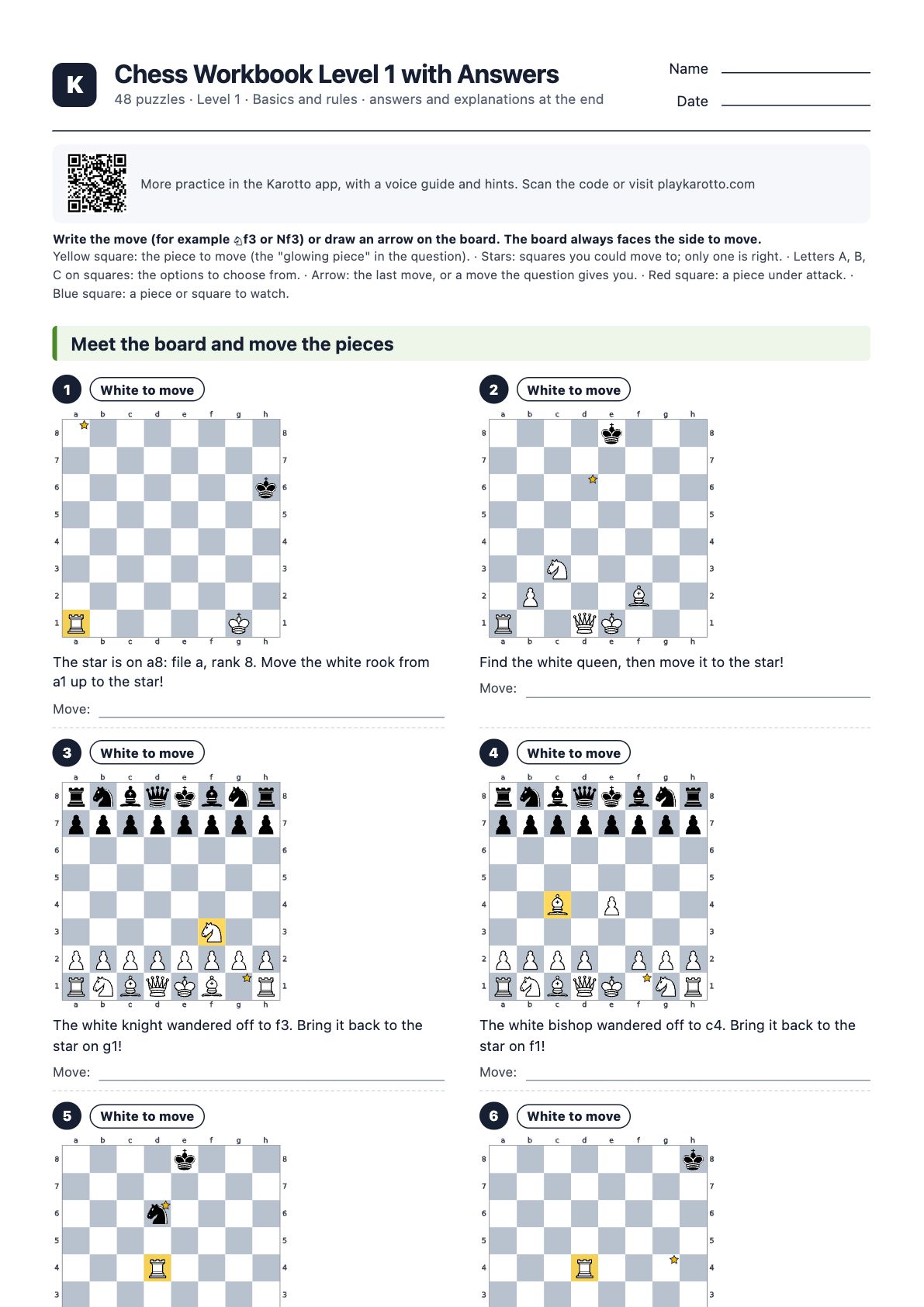
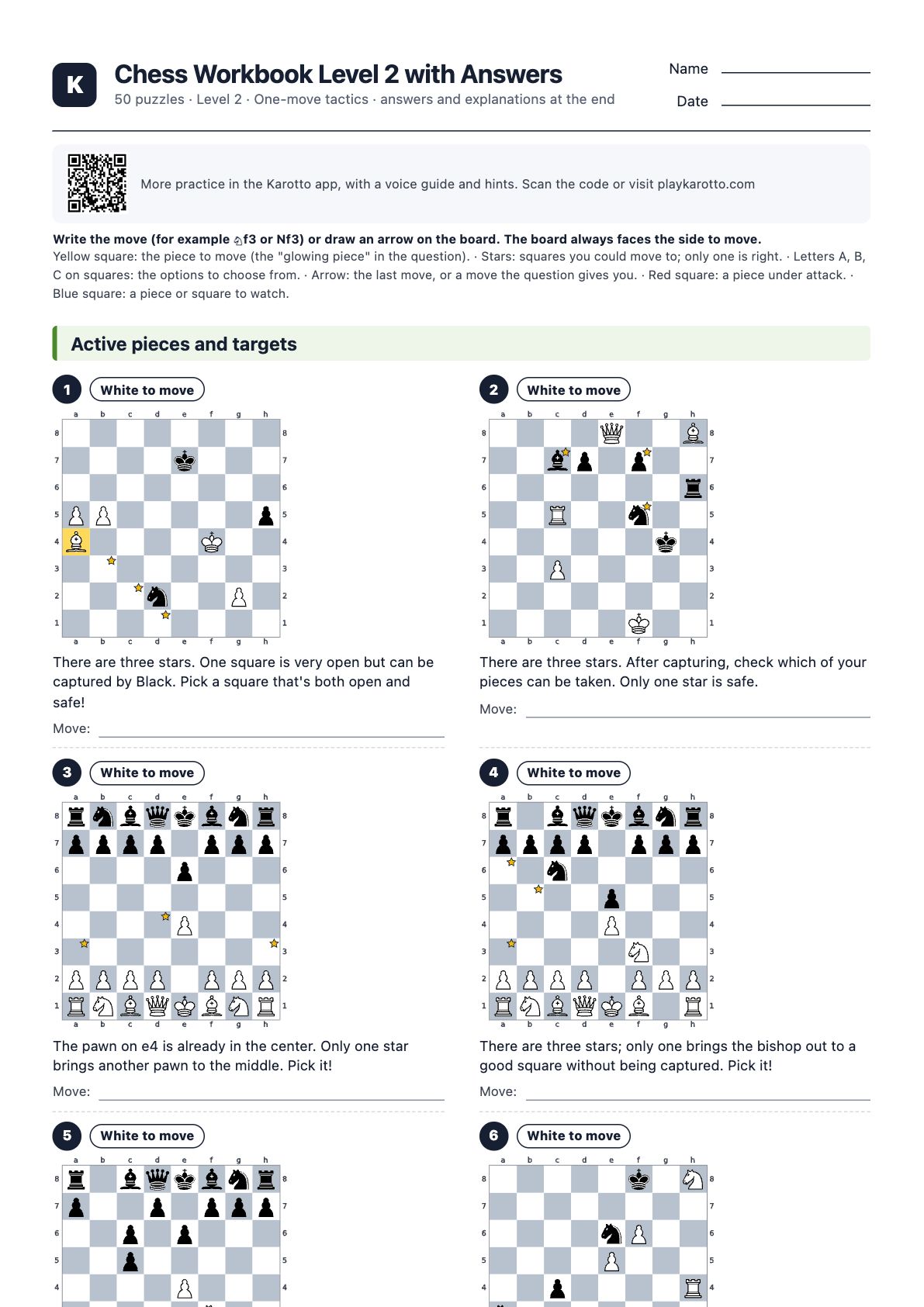
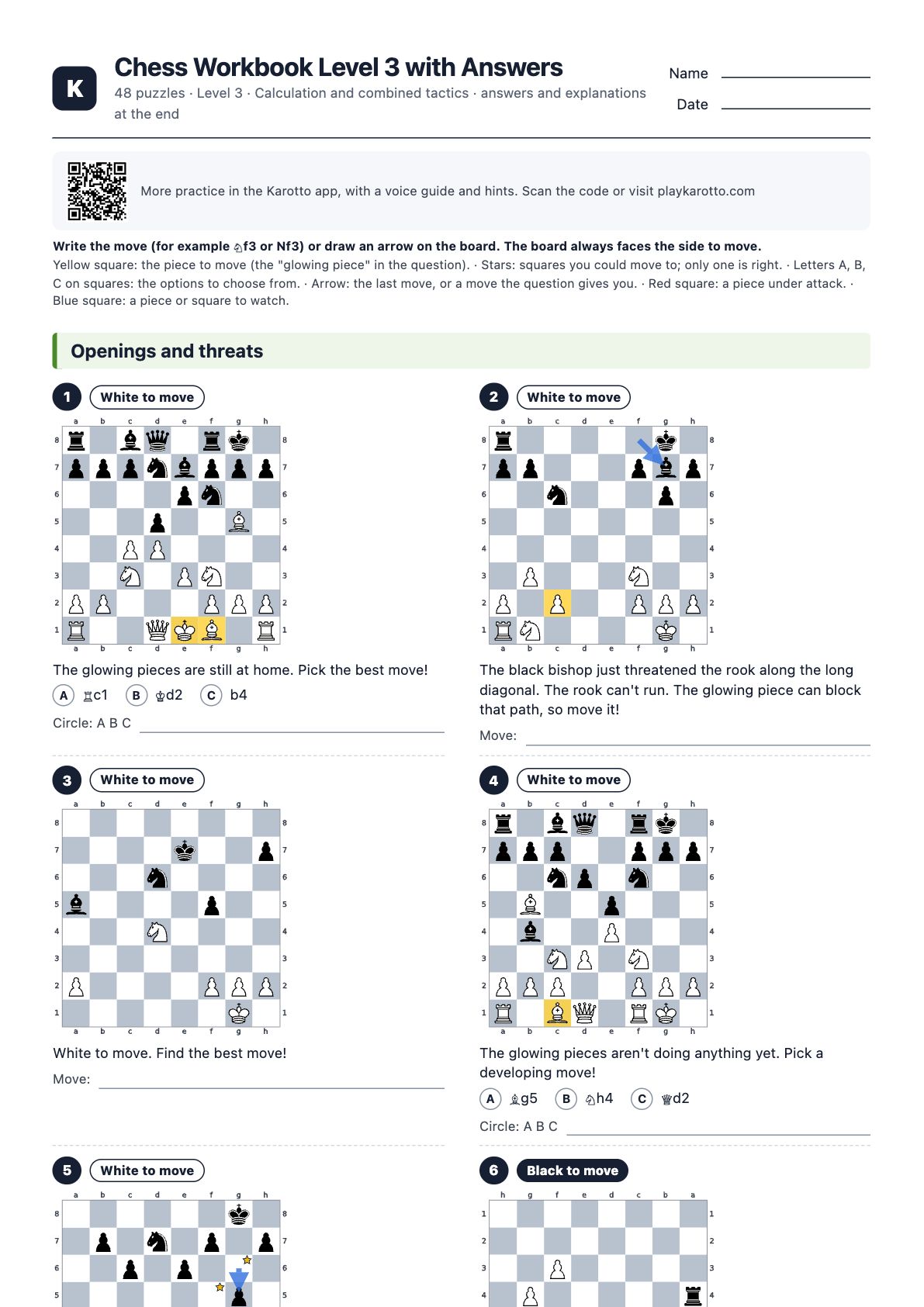
Chess workbooks by level (PDF)
Each workbook is split into the chapters of that level, from easier to harder. Answers and explanations are at the end of the file.
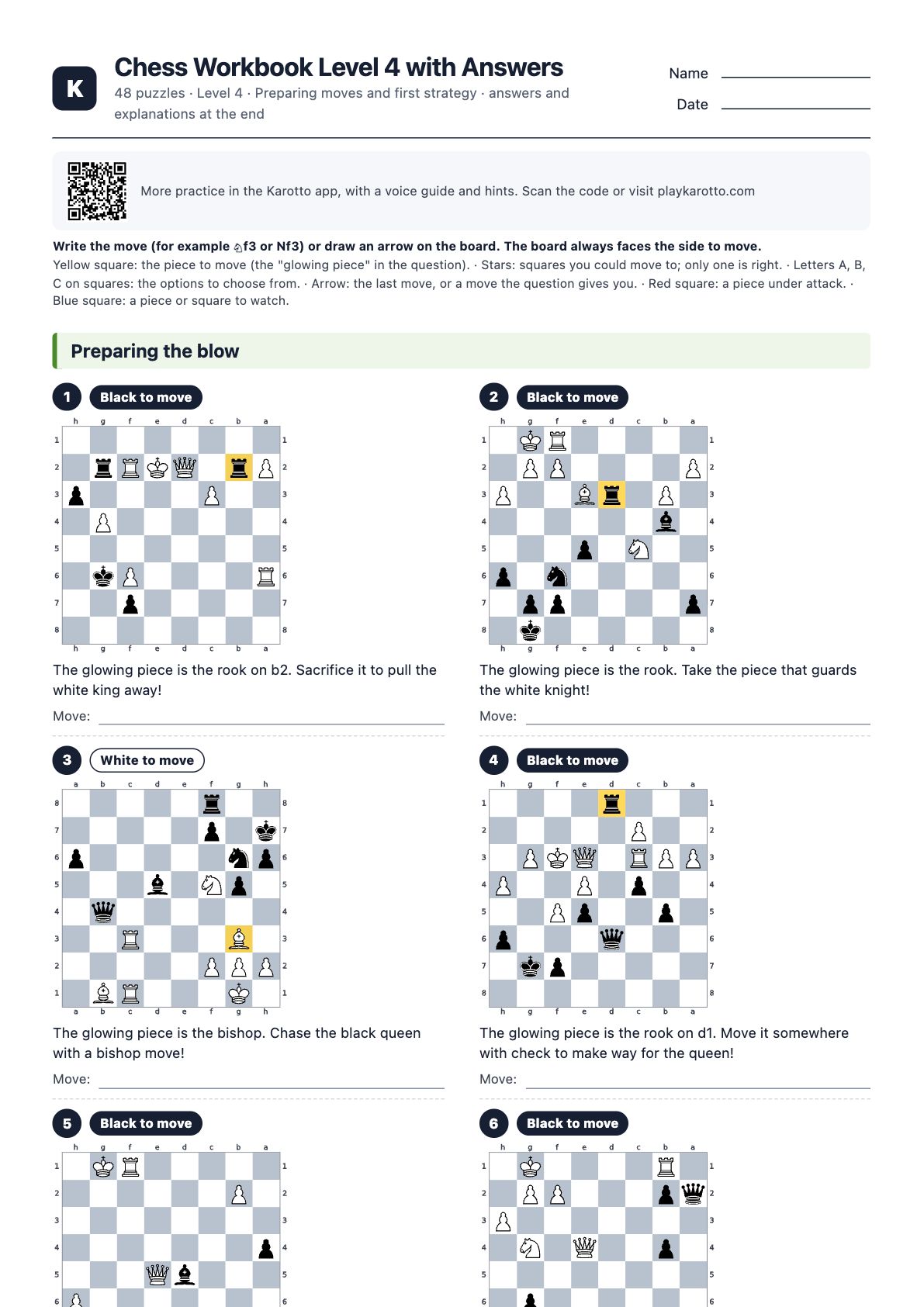
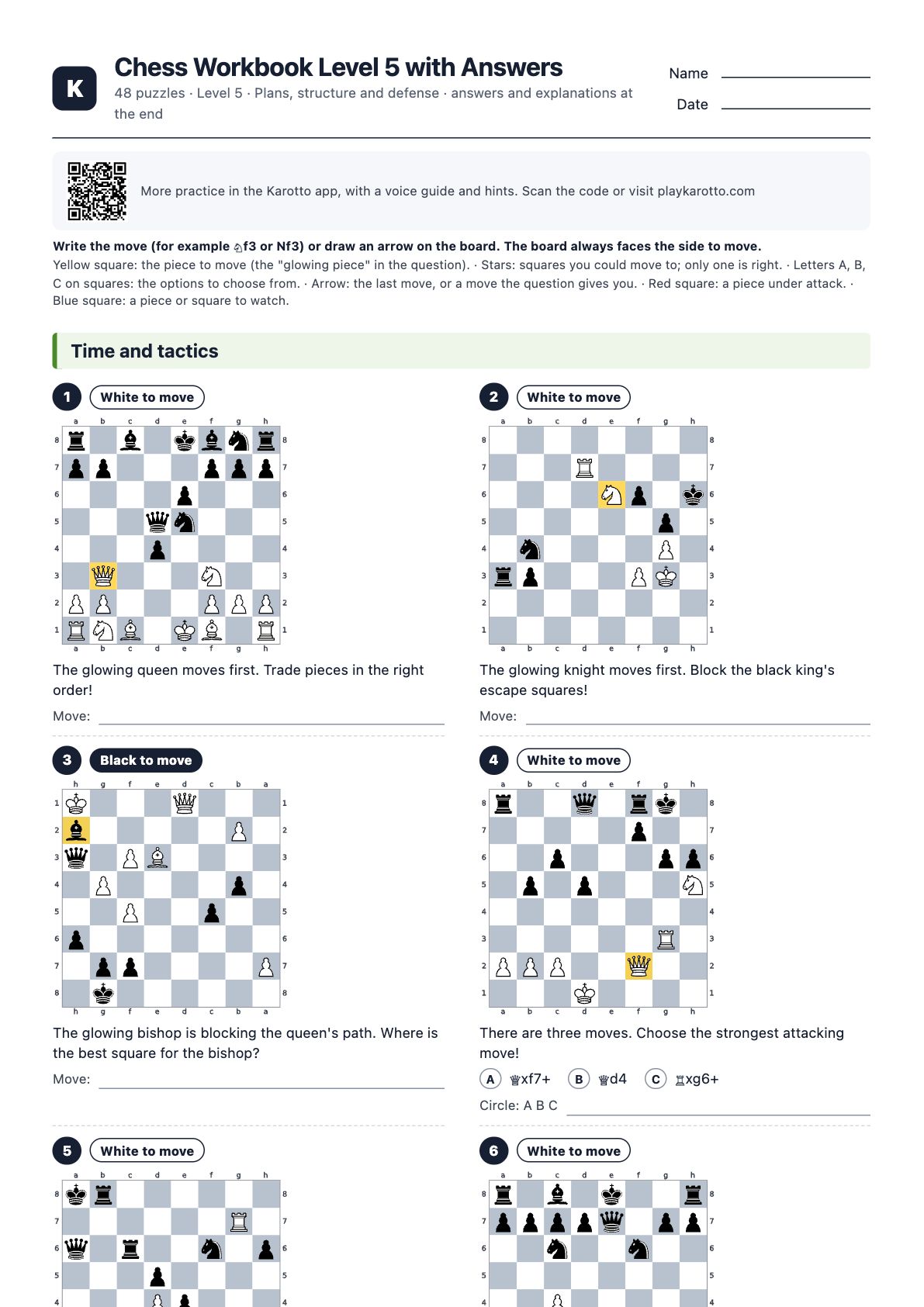
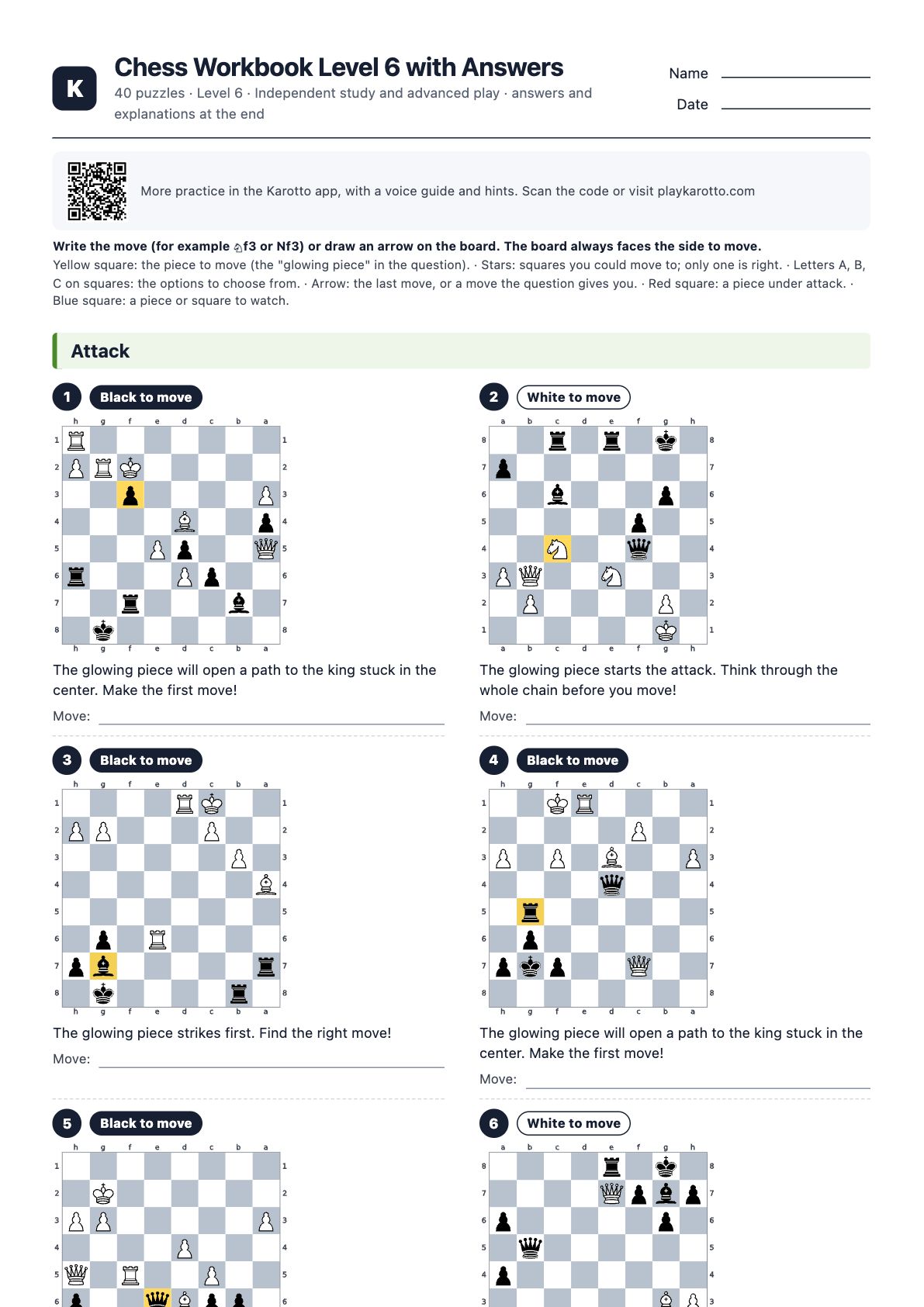
Chess worksheets by theme (PDF)
Each worksheet has up to 12 positions on one theme, ordered from lower to higher levels. Tap a group to see example puzzles.
Basics
How the pieces move, safe captures, protecting pieces, check and the three special rules. This is the foundation of level 1: make it solid before moving on to tactics.
Checkmate
From mate in 1, avoiding stalemate and stopping mate threats to mate in 2 and longer attacks on the king.
Tactics
Forks, pins, skewers, discovered attacks, removing the defender, decoys, trapped pieces and calculation.
Endgames
Passed pawns, pawn endings, rook endings, queen and minor-piece endings and how to save a draw.
Openings and strategy
Opening principles, opening traps, active pieces, pawn structure, rooks on open files and planning.
How to get the most out of these worksheets
- Set the position up on a real board: younger children learn best by moving real pieces. Older ones can solve from the diagram and write the move or draw an arrow.
- Ask "why?" before checking the answer: a puzzle is solved when your child can say why the move works. If the answer is wrong, play it out on the board and let them see the reply.
- A little every day: six positions per session is plenty. When your child solves about 8 out of 10 at one level, move on to the next.
- Yellow square: the piece to move (the "glowing piece" in the question).
- Stars: squares you could move to; only one is right.
- Letters A, B, C on squares: the options to choose from.
- Arrow: the last move, or a move the question gives you.
- Red square: a piece under attack.
- Blue square: a piece or square to watch.
Keep practising in the Karotto app
Each theme above is a lesson in the app's chess course, with a voice that reads every question, hints when your child is stuck, and a replay of the opponent's answer after a wrong move.
Frequently asked questions
Are these official Steps Method workbooks?
No. Karotto wrote these worksheets in six levels that roughly match Step 1 to Step 6, so parents and coaches can compare. Karotto is not affiliated with the authors or publisher of the Steps Method.
Are the PDFs free?
Yes. Print them as many times as you like for your own children, your class or your chess club. Please share the link to this page rather than uploading the files elsewhere.
Are the answers correct?
Positions and answers come from the chess course in the Karotto app. Answers are worked out by the app's own move checker, and positions from level 3 up were also verified with the Stockfish engine and endgame tablebases. Positions with more than one correct move were left out.
Which level should my child start with?
If your child has just learned how the pieces move, start at level 1. If they can already play a full game, try a few positions from the end of the level 1 workbook. If they get nearly all of them, go straight to level 2.
What does ♘f3 or ♕h7# mean in the answers?
The piece symbol is the piece that moves (♔ king, ♕ queen, ♖ rook, ♗ bishop, ♘ knight, pawns have no symbol) and the letter and number are the square it goes to. x means a capture, + is check and # is checkmate. 1, 2 number the moves, and … means Black moves first.